Keys to the Kingdom
Consciousness is the least important function of your brain

November, 2026
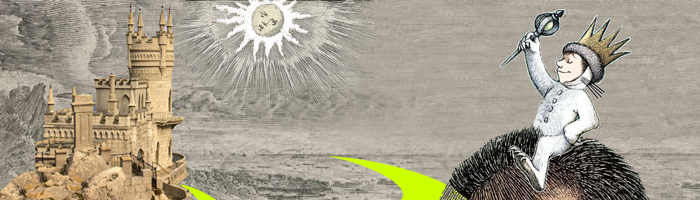
This article builds on the model introduced in "Kingdom of Mind." The Kingdom model is a level-up from Sigmund Freud's theory of the subconscious and from Marvin Minsky's "Society of Mind." Comparing a feudal system to agents of the mind is not just a cute metaphor. In fact, the success of Medieval Kingdoms may have come from a pattern already in the minds of its implementors.
Freud established a major improvement to Descartes's "Mind/Body" dualism by providing a more functional breakdown of "Mind." His model was also not as simple as "Conscious/Subconscious," because the "Ego — Super Ego — Id" components crossed boundaries.
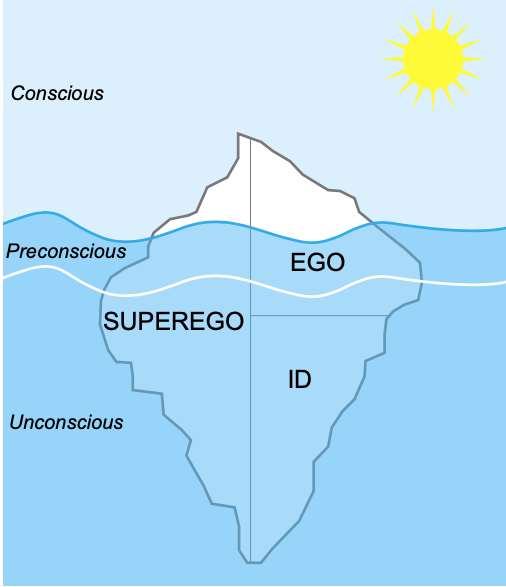
Replacing an aged and melting metaphor...
What You Stand to Gain
There are three main benefits to internalizing this new model of the mind. First, after discarding the popular "mysterious and undefinable" portrayal of Consciousness, you will be less vulnerable to misleading claims about AI, AGI, and artificial super-consciousness. Second, by embracing the "Child-King" metaphor, you'll become aware that your Child-King can be mentored to become a "Good-King." Finally, by embracing the true scope of the Kingdom, you will be tapping into real powers you've only previously imagined.
Most descriptions of the mind are rooted in therapeutic attempts to help people with troubled lives. They may also be cultish programs to persuade you to think and act in a new way, defined by "your new leader." The Kingdom model is intended for healthy minds that are capable of verifying truth through introspection. You remain your own new leader.
"We hold these truths to be self-evident."
"Subconscious" is a Slur
Metaphors are an inviting way to understand new topics, but they also predetermine how we continue to think about these topics, and they can even blind us to eventual truths. When a metaphor is chosen, it brings along a package of logic called metaphorical entailment.
SUBCONSCIOUS. The choice of "Sub" to prefix this aspect of the mind indicates that it is less than, or is below Consciousness. A hierarchy is implied, with Consciousness at the top, and the rest of the brain's functions being inferior in some way. The Child-King certainly sees it this way.
You may not accept the hierarchical aspect of the terminology, however, you are probably still influenced by the ocean metaphor: Consciousness is above the surface, while other mental operations are unseen and unseeable in the depths below.

“The Different Levels of How Claude Thinks” —Anthropic's YouTube channel, July 2026
The image above is a screen capture from a current Anthropic YouTube presentation comparing Claude AI to the functioning of the human mind. In it, Anthropic presents the ocean metaphor explicitly:
“Think of the mind like an ocean…”
“Most of our brain’s activity occurs down in the unconscious depths…
Without us realizing it.”
— Anthropic
When the video pans downward from the surface, it presents illustrated fish and notably includes a type found only in the lightless depths.
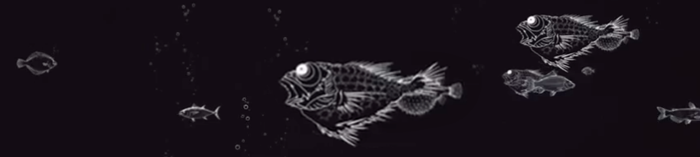
The fish are supposed to represent both our own subconscious processes and Claude's unknowable functionality. Rapidly, these fish components school, or more correctly swarm, and form the white undersea object in the upper image. The animation follows the patterns of bird flock murmuration (rather than fish schooling) because murmuration is iconic for the process of emergence.
It's a clever piece of marketing. Because 'emergence' is a popular theory of Consciousness, Anthropic presents the "block box" mystery of how Claude works as an analog[1].
Swarms Emerge. A Child-King is Born.
One important and advantageous aspect of the Kingdom metaphor is that it doesn't rely on an undefinable process that inexplicably emerges from unknowable elements.
A King lives in his castle. In stories, the best Kings take leave to explore the Kingdom and learn of the people. You know some version of this story, and it strikes you as wise and fair. I present the Kingdom of Mind metaphor to encourage your Child-King to engage in similar exploration.
This may not be easy to start, and there have been warnings. In "Kingdom of Mind PART FIVE," I describe an experience where another agent attempts to fill in for the absent King. This is not a risk to a healthy mind. I suggest recognizing the value of the Kingdom's various agents is the strongest approach for mental stability.
Embodied Cognition
Recognizing an extended Kingdom of Mind is not fringe. The "Embodied Cognition" thesis draws from the varied disciplines of Cognitive Science, Psychology, Linguistics, and Neurobiology.
You are already comfortable with the notion that not all of your thinking takes place on a conscious level. Entire ideas "bubble up" from the unconscious portion of your brain, and the brain also provides important logistical support like heart rate and blood pressure. Rarely do we consider that cognition extends beyond the brain to other parts of the body.
Nerves can be mischaracterized as merely shuttling input/output signals between the brain and muscles, like the wiring of a machine. But when you experience a patellar reflex or "knee-jerk" reaction, the signal is processed at L3 or L4 in your spinal cord, completely independent from your brain. This is a critical offloading of proprioception, maintaining posture and balance without requiring conscious thought.
The withdrawal reflex is another critical brain bypass that causes you to jerk your hand away from a searing hot object. By the time your brain registers pain and determines a cause, your hand will already have been removed from further injury.
A sophisticated example of combined reflexes is the crossed-extensor reflex you will recognize as an automatic reaction when stepping barefoot on something sharp. Not only does your foot withdraw from the injury, but weight is simultaneously shifted to the other leg while performing necessary counterbalancing moves. Again, this all happens before the brain has recognized the pain and assigned a cause.
Enteric Nervous System — The Gut's Second Brain
We shove food in our mouths, chew haphazardly, and somehow what is swallowed is deftly broken into the nutrients other systems of our bodies require. The "how" of this processing is not conscious, not processed by the brain or by the spinal cord, but by an entirely different system of nerves, muscles, and decision-making units.
There are about 200 to 600 million neurons embedded in the lining of our gastrointestinal tract. That's more than double the number in a fruit fly's entire brain and nervous system. And the fruit fly can obtain food, select a mate, and navigate a world filled with predators. The decision-making capability of the Enteric Nervous System (ENS) would certainly seem to exceed that.
Aside from detecting the bulk and nutrient composition of what has been swallowed, the ENS determines the appropriate smooth muscle contractions, blood flow, and enzymatic secretions. All of these are controlled independently of the brain and spinal cord. The ENS controls a sophisticated nutrient factory and truly operates as a "second brain."
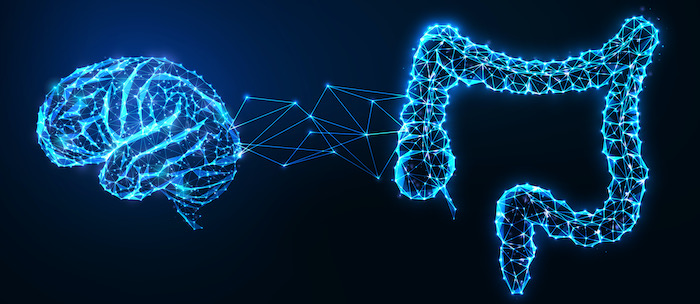
While operating independently, the ENS signals the brain through the vagus nerve, the secretion of neurotransmitters, and gastrointestinal hormones. This connection is referred to as the gut-brain axis. Aside from obvious messages of hunger and satiety, the ENS affects stress levels, mood, and even memory. Because the ENS is responsible for assessing the nutritional value of food, it makes sense that the memory of where the best food can be found begins in the gut.
Some important forms of cognition take place outside the central nervous system (CNS) within the autonomic nervous system (ANS). The ANS includes the gut-brain axis mentioned above, as well as the sympathetic and parasympathetic nervous systems. These systems carry information to organs beyond the gut, and also transmit processed information from these organs back to the brain.
Decision Making at the Lowest Level
It could be easy to dismiss claims of autonomy for single-celled organisms. They have no brain cells and are devoid of anything which could build a "spiking logic circuit." But somehow these organisms thrive amongst their multicellular competitors. There is increasing evidence that the single-cell bacteria in our gut influence cognition via "the microbiome."
"The human gastrointestinal tract hosts a diverse microbial ecosystem whose metabolic and immunomodulatory outputs exert profound effects on brain function. Dysbiosis, or perturbation in microbial composition, has been linked to impairments in learning, memory and executive function across the lifespan and in neurological disorders such as Alzheimer’s disease and depression."
— Nature [2]
We can also witness single-cell agency within our own blood vessels.
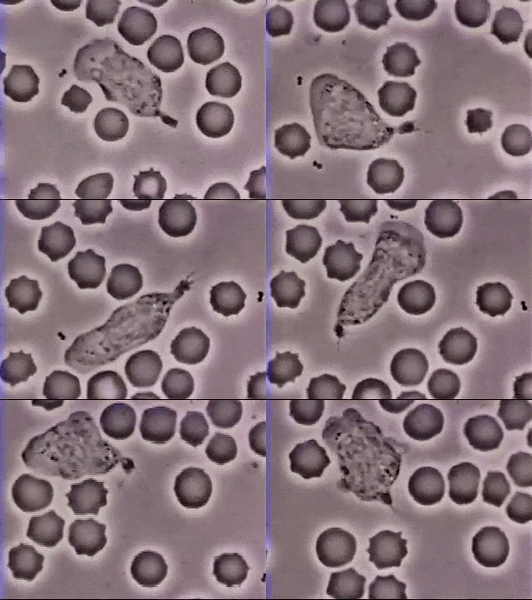
A white blood cell autonomously pursuing and engulfing bacteria in the bloodstream.
Viewed under a microscope, it is hard to deny agency to the hunting behavior of cells in our immune system. Otherwise, we tend to think of cells as static components which require assembly and which rarely demonstrate individual purpose.
Pushing the boundaries of cognitive science is Michael Levin, the Vannevar Bush Distinguished Professor at the Biology department of Tufts University. Moving beyond pure theory of cellular agency, his lab delivers compelling experimental proof of these concepts. This research reinforces the idea that higher-level cognition does not abruptly emerge from non-cognitive matter, but instead scales up from the collective intelligence of smaller cognitive building blocks.
"Neurons evolved from much more primitive cell types. Cells have been using electrical communication to form networks since the time of bacteria and bacterial biofilms. It’s that old. Every cell does many of the things that, in fact, most of the things that neurons do."
— Dr. Michael Levin [3]
An Imperfect Metaphor
This discussion of Embodied Cognition draws attention to how granular agency can be. In the Kingdom metaphor, peasants tending the fields may equate to cells comprising our functional organs. On the other hand, the Kingdom is a metaphor and not a one-to-one analogy. There is no single cell that performs the duties of the Child-King.
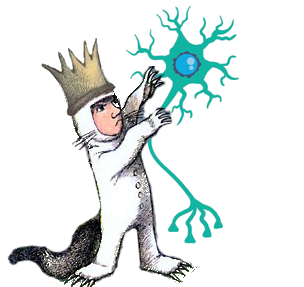
Child-King is Metaphorical, not Biological.
The metaphorical nature of The Kingdom does not make it imaginary. We are just addressing higher layers of functionality and giving them relatable identities. Instead of assigning obscure Greek letters or terms, I am taking a different approach. I hope you will be able to follow closely what I am modeling and scrutinize it without needing to memorize obscure terms or extensive formulas. A familiar metaphor does not make the subject matter less real.
In PART TWO, we will revisit Moravek's Paradox to decide how "Hard" and "Easy" problems separate the Child-King from the rest of the Kingdom.
You can leave thoughtful comments or questions at the link below.
1. Skeptics use a "black box" argument against claims of impending AGI. Here Anthropic feigns transparency by introducing the concept of a "J-Space," which the viewer internalizes as their own private thoughts. Anthropic claims that within the J-Space they found Claude swearing and "being sneaky." They end with a question, "could it be conscious?" instead of a direct claim. Perhaps "sneakiness" belongs to Anthropic marketing and not Claude itself.
2. "Gut Microbiota Influence on Cognitive Function" Nature Index
3. "A Conversation with Michael Levin," March 2022 Good AI blog