Keys to the Kingdom PART TWO
Consciousness is the least important function of your brain

November, 2026
Previously on Keys to the Kingdom...
In Part One, we expanded on the Kingdom of Mind metaphor and defended its validity based upon the science behind Embodied Cognition.
Revisiting Moravec
In "Kingdom of Mind" I introduced "Moravec's Paradox" (1988) from computer science. In a nutshell, it observed, "the hard things are easy, and the easy things are hard" when assessing progress in artificial intelligence.
The "easy things" are survival tasks we witness "simple" creatures performing daily. They would include the perception and motor skills of a one-year-old child. The "hard things" are like puzzles, games, or winning at Jeopardy!.
When Moravek wrote about this seeming paradox, the "hard problems" were solved through "Classic Artificial Intelligence." This technique is not the LLM or Neural Network approach marketed as AI today. "Success" was declared when a computer could finally outperform human world champions. The 1990s saw human game supremacy fall for Checkers, Othello, and Scrabble. And Deep Blue (IBM 1997) famously beat chess champion Gary Kasparov.
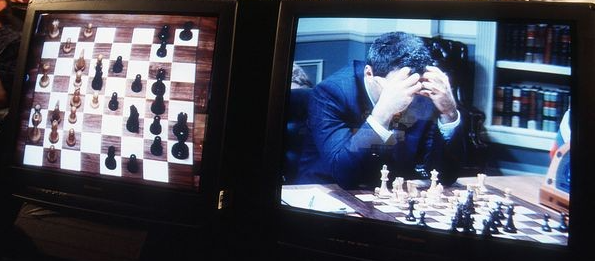
Deep Blue could evaluate 200 million chess positions per second.
The ability to consider most, if not all, possible moves in games of "perfect information" meant that brute-force and advanced computing would eventually overpower human efforts. Deep Blue could evaluate 200 million chess positions per second. It still used the same narrow problem-solving approach as earlier programs. But Watson's (IBM 2011) victory over Jeopardy!'s human champions signaled something significantly different.

Watson used an architecture similar to ideas proposed by Marvin Minsky's "Society of Mind."
Watson used probabilistic reasoning to parse 15 terabytes of encyclopedic text for each question and then evaluated thousands of potential answers. It utilized consensus from 200 or so algorithmic approaches. Like the human players, Watson had to calculate the "confidence level" of its best guess, and then manage the buzzer timing and wagering algorithm. It creamed the human players. Champion Ken Jennings concluded his Final Jeopardy! answer with, “I for one welcome our new computer overlords.”
“The great thing about the software architecture of Watson is that it does not rely on any one algorithmic or heuristic method to make its decisions. Watson's builders used what I like to call a “hybrid architecture.” Marvin Minsky calls [hybrid architecture] the “kitchen sink model of the mind.” Anything you can think of that will work, put it to work, and the Watson people did.”
— Edward Feigenbaum [1]
Hans Moravec did not participate in solving the "hard problems" of chess or Jeopardy!. In the 1970s he built an autonomous robot cart which could navigate around the Stanford AI Lab. This is where he learned that an "easy problem" like navigating the world was very hard to solve. A monarch butterfly, with its minuscule brain, will navigate thousands of miles across North America, so it should seem to be an "easy problem." On the other hand, no other species, despite endless training, could beat a grandmaster at chess or Jeopardy!. So those kinds of problems are "hard."
The Child-King of Hard Problems
In Kingdom of Mind, we identified the Child-King as the portion of the mind responsible for solving the "hard problems," while it delegates "easy problems" to the rest of the Kingdom. The Kingdom takes care of the easy problems even without royal instruction. Nevertheless, the hard problems actually are hard!
Part of the criteria determining hardness is that the problems actually require the Child-King (frequently called "Human Consciousness") to solve them. Supposedly, evolution has already solved the "easy problems" and spread their solutions amongst the many creatures. "Hard problems" are new, and evolution hasn't had a chance to crack those. Although the evolutionary paradigm says evolution created the Child-King, so maybe it did provide the solution after all.
Why are the hard problems easy to solve?
Theory of Mind is how your Child-King anticipates the behavior of other presumed conscious entities. The self-reflective nature of "How would I approach this?" works well on other minds, but it also works well on transcribing those anticipated behaviors into steps. It is ironic that the Child-King can externalize its solutions to "hard" problems (like programming a computer to play chess), yet it still remains disconnected from the "easy" solutions provided by the Kingdom (like balance and navigation).
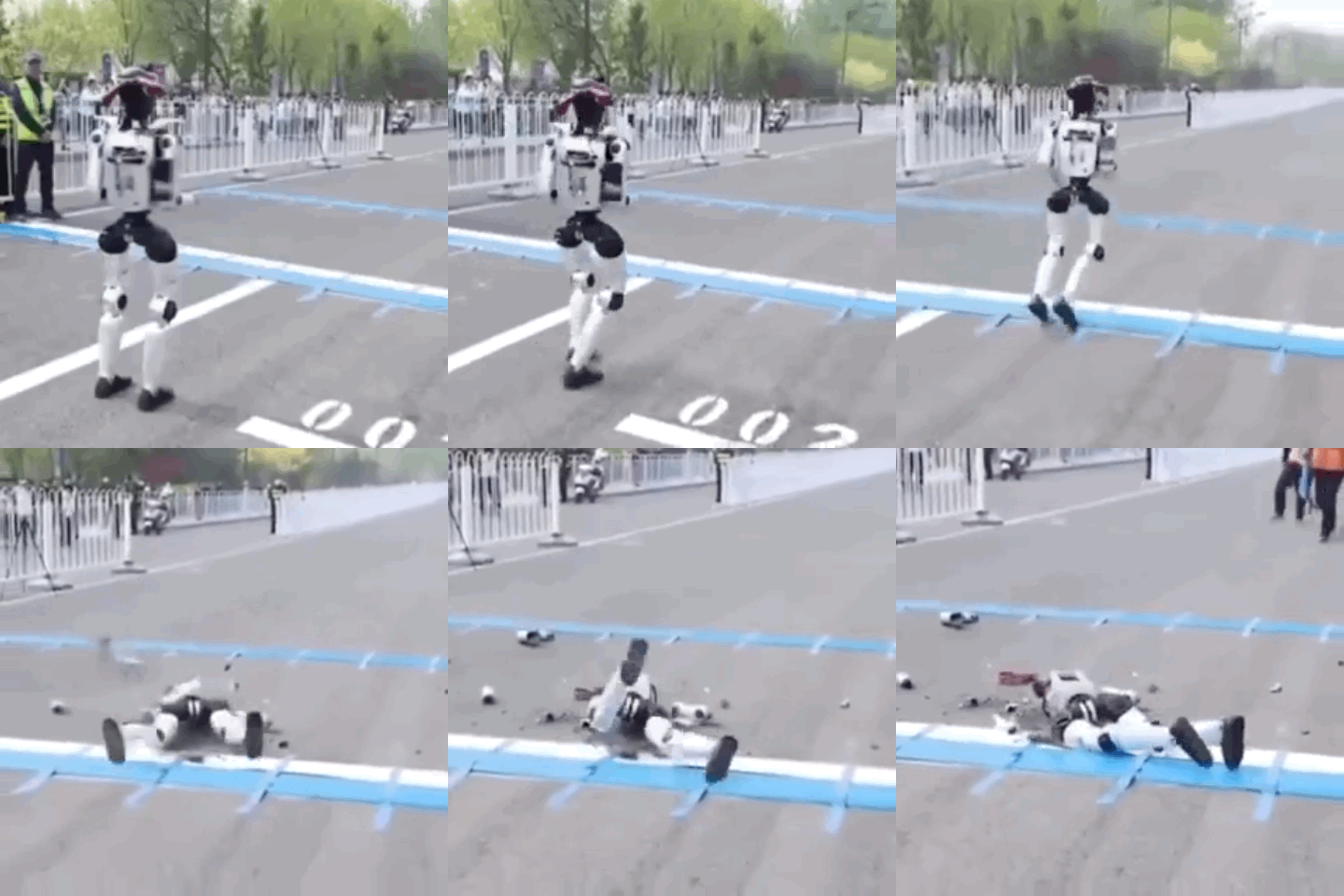
Journey of a 1000 Miles Begins with the First Step.
Self-Awareness is Programmable
Another conceit of the Child-King is that the property of self-awareness is mysterious and undefinable. Engineered feedback loops have been a staple since the Industrial Revolution. Loops are categorized as "open loop," like the trajectory of a cannonball, or "closed loop," like the trajectory of a self-guided missile. The missile has a goal state and periodically gets information about its progress, and has a control mechanism to make mid-flight corrections to its trajectory. It has a small window of self-awareness, but the number of properties tracked can increase depending on the application. There are many industrial manufacturing systems with exhaustive self-diagnostics and corrective maintenance. Every living cell does the same thing. In fact, the structure of DNA differs from the RNA it will transcribe because it's optimized for damage detection and repair.
Building Artificial Consciousness is elusive because other models of the mind incorrectly include parts of the Kingdom for which the Child-King has no awareness. But the "hard-problem" of building an Artificial Child-King (ACK) can be facilitated by the Child-Kings of the engineers themselves.
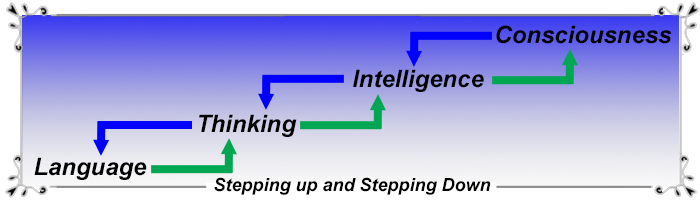
The ascendence of Language to Consciousness is assumed to climb the green arrow.
Not every aspect of the human "consciousness stack" seems desirable to include. The Minstrel agent, which injects unrequested music, seems counterproductive. Would the outside auditory input of the Advisor be a best practice technique? Teasing apart the stack of agent layers in "human consciousness" is critical to designing an appropriate architecture.
"The internal character of 'I' is always associated with the Spectator, but it also projects itself into other aspects of Consciousness — typically, the Child-King. The common stack of Consciousness would be: The Spectator, the Recorder, the Child-King, and Spotlight Attention. During those times, the Child-King takes credit for the output of all aspects, proclaiming, 'Behold, I am Consciousness!'"
— Darren Lott, "Kingdom of Mind PART Six"
We can build an Artificial Child-King. We have the technology. But as far as replicating the rest of the Kingdom, we have almost no idea. Does it begin with Language?
In PART THREE, we will take a deeper dive into Natural Language Understanding and the first AI Chatbot ELIZA. Hopefully this provides an inoculation against the dangers of AI Psychosis.
You can leave thoughtful comments or questions at the link below.
1. "IEEE Annals of the History of Computing" March 2013 Feigenbaum Interview
2. "My Opinion of Noam Chomsky's Theories" YouTube 2013 Minsky Interview