Keys to the Kingdom PART THREE
Consciousness is the least important function of your brain

November, 2026

Previously on Keys to the Kingdom...
In Part One, we expanded on the Kingdom of Mind metaphor. I defended its validity based upon the science behind Embodied Cognition.
In Part Two, we revisited Moravec's Paradox and how classic AI defeated Human Champions at everything — no artificial Neural Networks required.
Imprinting and the ELIZA Inoculation
A portion of cognition is hardwired into the Kingdom by evolution. We call this "Instinct." These instinctual behaviors are critical to getting a newly born creature "up and running" before any appreciable time for learning has been afforded. Some instincts also stay active beyond infancy, and even subsequent counter-learning makes these hard to extinguish. Because they operate within the long timeline of evolution, predators can learn about these instincts and exploit them.

Instinct can set innocents onto a path of safety or destruction...
Within hours of birth, baby ducklings form a permanent bond with the first moving object they experience. This is usually their mother. "Feel good" stories of interspecies cooperation feature ducklings imprinting on humans, dogs, cats, or other animals. These stories belie the horror of imprinting on a predator who has recently killed their mother.
Humans are born with "newborn reflexes" like grasping, sucking, and reactive positioning. These are replaced by more intentional actions by the first year. After that, human instincts can be broadly categorized into: Self-Preservation, Procreation, and Socialization. All three of these benefit highly from the human "Theory of Mind" capability. We instinctively want to detect other minds and figure out what they are thinking.
Pareidolia comes from a hard-wired brain mechanism for detecting faces, even in random noise. I wrote an article about Pareidolia here.
Detecting human faces is a great way to discover other minds, but discovering human language is an even stronger signal. Written language, especially interactive discourse, will draw a human into instinctual "Theory of Mind" behavior. There is nothing in our evolutionary past to moderate this response.
From 1964-67, Joseph Weizenbaum built ELIZA, a natural language processing program that could carry on an interactive dialog in English. Despite using only basic pattern matching and substitution, ELIZA gave some users the illusion of understanding. I wrote more about ELIZA here.
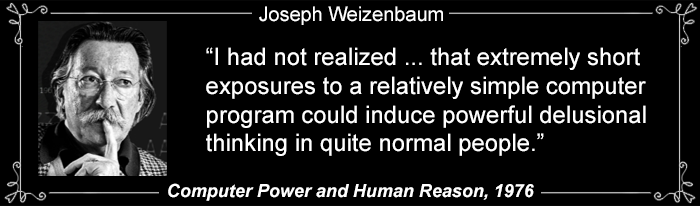
I was fascinated by ELIZA and played extensively with a copy in 1985. Rather than induce a delusion of artificial consciousness, ELIZA worked like an inoculation for me. It provided enough of a tease to surface my own vulnerability to 'Theory of Mind' misattribution. And it put me on guard against similar false attributions in the future.
Noam Chomsky: Why We Can't Have Nice Things
There are many reasons to dislike Noam Chomsky. I won't waste a footnote on him even though he is considered the father of modern linguistics. His most salient feature to me is how much his legacy was reviled by MIT colleague Marvin Minsky.
“For maybe 30 or 40 years, support for semantics and how language actually works virtually vanished from the planet earth. Most linguistics departments changed their linguistics departments to grammar departments and theories of formal syntax. It is a phenomenon I hope to never see again, where an important field is replaced by a relatively unimportant one.”
— Marvin Minsky [1]
The important callout is SYNTAX, which can be paired or contrasted with SEMANTICS.
Syntax can be summarized as the structure of a sentence, whereas semantics is the meaning of the words: Rules versus meaning. Chomsky's approach to language was to separate the grammar of a sentence from its possible meaning. His famous example was:
"colorless green ideas sleep furiously,"
which is both grammatically valid and semantically meaningless.
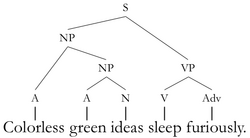
Syntax Tree within Chomsky's Generative Grammar:
NP = Noun Phrase
VP = Verb Phrase
A = Adjective
N = Noun
V = Verb
Adv = Adverb
The issue is not that the rules of language are unimportant, but rather that the meaning of words is critical. And the field moved on to believe otherwise.
For Minsky and the early AI community, this was lamentable. They believed AI required Natural Language Understanding (NLU) — real comprehension, and not just grammar validation and simplistic word association as used by ELIZA.
Terry Winograd was a major pioneer in Artificial Intelligence with his language-interfaced program SHRDLU. I wrote more about Winograd in the intro to Blocks World.
Winograd is also notable for his contribution of "Winograd Schemas." These were challenge sentences to test if computers could understand the meanings of words in a sentence. The classic example is as follows:
"The city councilmen refused the demonstrators a permit because they [feared/advocated] violence."
The challenge question was "Who does 'they' refer to, the councilmen or the demonstrators?" Depending on whether "feared" or "advocated" is inserted, a human will immediately know, but a computer will have to guess. Collections of these types of "Winograd Schema" challenges were assembled and used as "Turing Test" enhancers. The intent was to reveal whether programs could apply common-sense reasoning and understand the meaning of words.
Words as Numbers
If you don't have the ability to comprehend word meanings, are there still methods for appearing to understand language? Yes.
One method is to pattern-match to preselected words. You then assign the matched words a priority number. From there, you continue by working with the highest priority. This is exactly how ELIZA handled the problem in the 1960s.
Let's utilize a current JavaScript port of ELIZA:[2]
ELIZA: How do you do. Please tell me your problem. ME: colorless green ideas sleep furiously ELIZA: Do you feel strongly about discussing such things? ME: colorless green ideas dream furiously ELIZA: What persons appear in your dreams?
Weizenbaum's design for ELIZA is not thrown off by the meaningless semantics of my input. It does not parse the sentence like a Chomsky linguist might. Instead, it breaks the input string into substrings (words) separated by the spaces. Then it looks for word matches in its mini database.
For the first input sentence, "colorless green ideas sleep furiously," none of the words match the database, so it classifies the input as "none" and scores it a 0. There are only seven phrases it can pick from:
- "I'm not sure I understand you fully."
- "Please go on."
- "What does that suggest to you ?"
- "Do you feel strongly about discussing such things ?"
- "That is interesting. Please continue."
- "Tell me more about that."
- "Does talking about this bother you ?"
ELIZA responded by randomly picking the fourth one.
I suspected ELIZA would have a priority score for "dream," so I substituted it for "sleep." This results in a score of 3 and provides four possible responses. ELIZA picked the third:
- "What does that dream suggest to you ?"
- "Do you dream often ?"
- "What persons appear in your dreams ?"
- "Do you believe that dreams have something to do with your problem ?"
Scores are important when many of the words have a match. The response comes from selecting one of the few choices pre-assigned to the highest-scoring word. To demonstrate how priority works, I responded:
"I dreamed my mother told me not to talk to computers."
- dreamed = 4
- my = 2
- mother -> family = 0
- computer = 50
ME: I dreamed my mother told me not to talk to computers. ELIZA: You don't think I am a computer program, do you?
This type of apparent self-reflection helped ELIZA outperform GPT-3.5 on the Turing Test in 2023.
Persona Scripts
ELIZA's apparent intelligence is due to very clever trigger words and response selections by Joseph Weizenbaum. Any perceived intelligence originates from him. He programmed the main parsing engine to handle basic substitutions and keep responses grammatically reasonable. The trigger words and response selections are kept in a separate data "Script." The famous one I've been demonstrating is named DOCTOR. Part of the brilliance of DOCTOR is that it encourages "patient" self-reflection merely by restructuring the input words. It does this without ever understanding their meaning.
Because of its nature as data, DOCTOR could continue to have more and more words and phrases added to its script. It would seem to learn and get smarter. With access to thousands of actual patient transcripts, you could probably analyze word and phrase frequency to speed up the process for enhancing DOCTOR.
If you wished to create another persona, say MECHANIC, not much of the data would be reusable. The importance of trigger words would change, as would any possible responses. Let's try a pretend comparison:
ME: I think that it's smoking. DOCTOR: Have you considered quitting? ME: I think that it's smoking. MECHANIC: Where is the smoke coming from?
To enhance ELIZA to become a general conversationalist would take far more work than the success of DOCTOR would suggest. Just building a single useful persona beyond DOCTOR has proven insurmountable since the 1960s.
Word2Vec
A major impediment to expanding the conversational capabilities of ELIZA is the architecture's prioritizing of a single word and its single priority value. Also, tremendous human effort is required for each of those assignments. Could the process of selecting words and values be more automated?
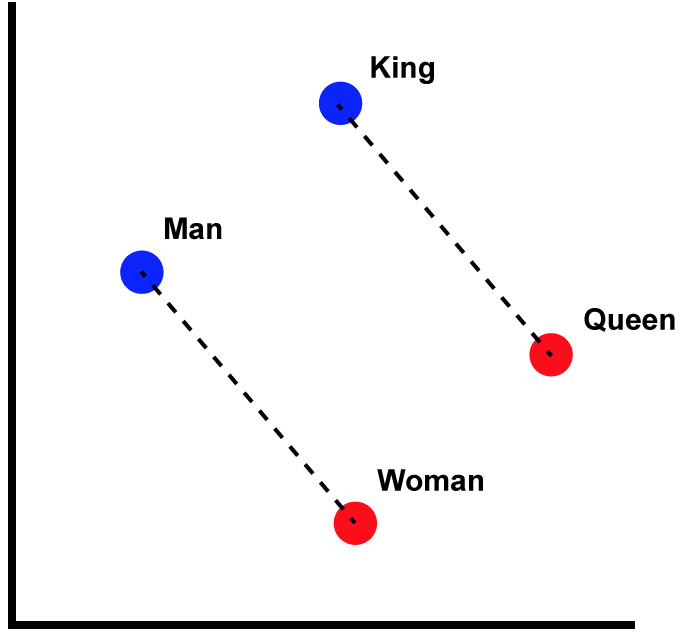
A breakthrough came with automated word embedding, most notably the Word2Vec techniques introduced in 2013. Instead of a single priority value per word, there are multiple dimensions, each with a numerical assignment. While there might be around 300 dimensions in actual use, two dimensions are frequently visualized as the row and column assignment on a spreadsheet or grid.
To calculate these numbers without human intervention, the algorithm uses a sliding window to analyze the immediate context of a word—looking at a span of 2 to 5 words before and after it in a sentence. By mathematically analyzing how often words appear next to each other, the system calculates probabilities of word occurrences and adjusts their coordinates across an entire corpus of human-based writing.
“You shall know a word by the company it keeps.”
— J. R. Firth, 1957 [3]
The claim of Word Embedding is that it encodes the MEANING of each word by assigning it a position in "vector space," close to other words with similar MEANING. Claiming that position in a sentence (SYNTAX) provides the missing meaning of a word (SEMANTICS) is something that echoes back to Chomsky and his disciples. Add in that current embedding techniques include some form of "neural network" and you might be forgiven for thinking "artificial intelligence has deciphered the meaning of language through math."
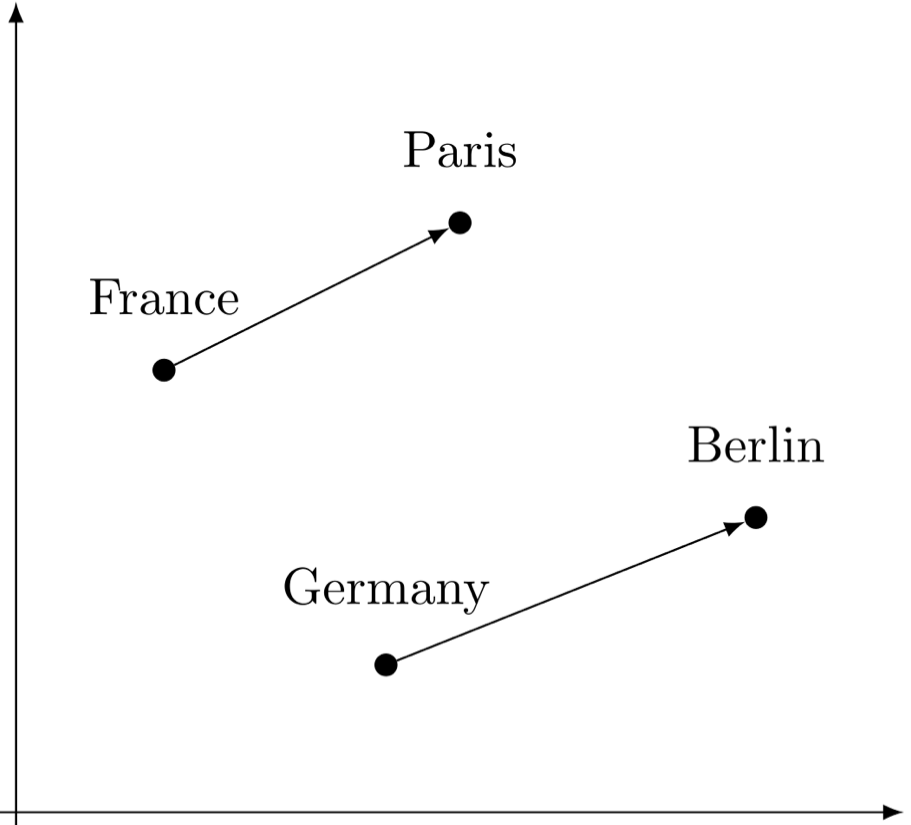
The diagrams from Wikipedia (above) are trotted out to demonstrate the apparent magic of this methodology. In "semantic space," the distance between the words "King" and "Man" can be calculated numerically. If you shift the origin to "Queen" by the same distance and direction, you will encounter "Woman." Amazing! The artificial brain has apparently figured out the concept of Gender among the myriad things it "knows" about royalty. Or has it?

"Do Not Arouse the Wrath of the Great and Powerful OZ!"
Given that the technique works by comparing words in the same sentence, "King" and "Man" seem like possible but infrequent co-occurrences. HOWEVER, the use of pronouns in English sentences like "The King, he ..." and "The Queen, she ..." would provide a solid distance link, without any meaning established. "Man" and "he" would also have frequent co-occurrence, as would "Woman" and "she." This is just the transitive property: A = B and B = C therefore A = C. By omitting the interim step, the advocates of embedding are overclaiming AI's ability to generate meaning from math. For the City-Country example, "is the capital of..." is the all-too-common phrase hiding behind the curtain.
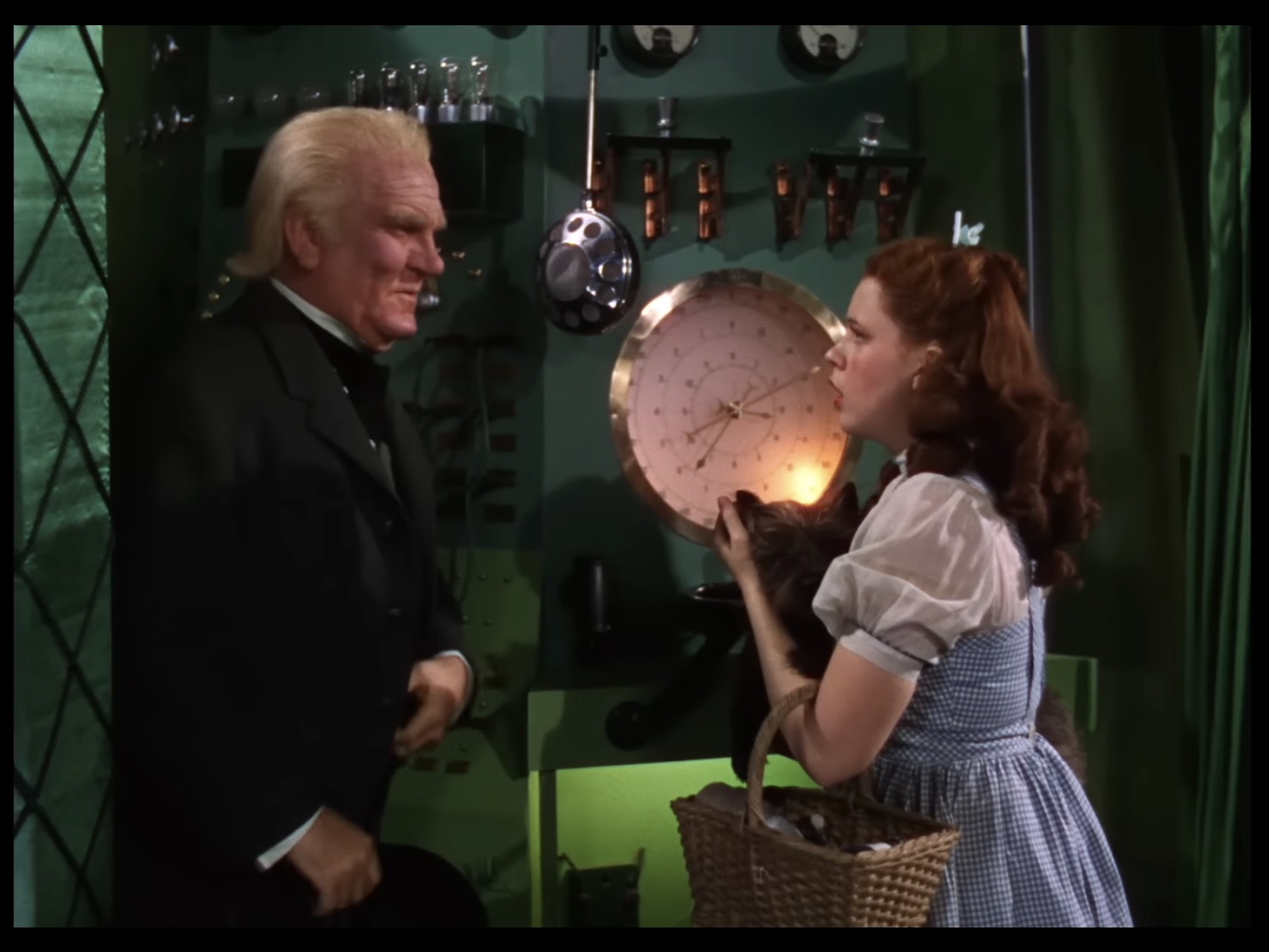
"No Dear, I am a Very Good Man. I'm Just a Bad Wizard."
ELIZA provides an excellent example of the "ELIZA Effect," causing some people to project human comprehension onto a very simple program. The DOCTOR script is successful despite utilizing only 42 base keywords. (You can check the data file here: Elizadata.text ). If ELIZA was expanded with 4,200 keywords it would seem even more impressive, but you should still recognize that genuine meaning had not emerged "because scale is all you need."
Any notion of "meaning" in modern AI comes from the human-written text it was trained on. It's essentially the same as what Joseph Weizenbaum did with ELIZA, except millions of people unwittingly participated via the internet. As humans, we encode meaning into words and arrange the words in sentences to create new ideas. But where does the initial meaning come from? Is establishing meaning one of the "hard" or "easy" problems?
In PART FOUR, Consciousness is not the True Source of Meaning.
You can leave thoughtful comments or questions at the link below.
1. "My Opinion of Noam Chomsky's Theories" YouTube 2013 Minsky Interview
2. "elizabot.js" Norbert Landsteiner 2005 ELIZABot
3. "Studies in Linguistic Analysis" John Rupert Firth, 1957