Keys to the Kingdom PART FOUR
Consciousness is the least important function of your brain

November, 2026
Previously on Keys to the Kingdom...
In Part One, we expanded on the Kingdom of Mind metaphor. I defended its validity based upon the science behind Embodied Cognition.
In Part Two, we revisited Moravec's Paradox and how classic AI defeated Human Champions at everything — no artificial Neural Networks required.
In Part Three, we saw how Theory of Mind causes us to project understanding onto things that can't comprehend meaning. This is known as the "ELIZA EFFECT."
Consciousness is Not the True Source of Meaning
None of the current AI programs can comprehend meaning. They can't grasp a situation or handle tricky exceptions. The language origin of each of these words — comprehend, grasp, handle — begins by knowing what it is like to have hands!
If I look away from hand metaphors, I can deflect your focus to another perspective. Is it clear that my etymological vision relies on physical insights from The Kingdom? Aye! (Eye).
When we search the origins of words, they all seem to be "grounded" in direct experience with the world. Actually, this is important. Because we use words to communicate with other minds, the meaning of the words should come from shared experiences. These will have a sensory or emotional underpinning that can "be felt."
In trying to find examples counter to bodily metaphors, I selected two words, which seemed most abstract: 'Trust' and 'Theory'. But it turns out that in battle, a 'Trust' was a circle of handpicked warriors with which the leader would surround himself. 'Theory' was another group of people who had been sent to consult an oracle and would return with their interpretation. Follow abstractions back in time and they seem to originate with physical events.
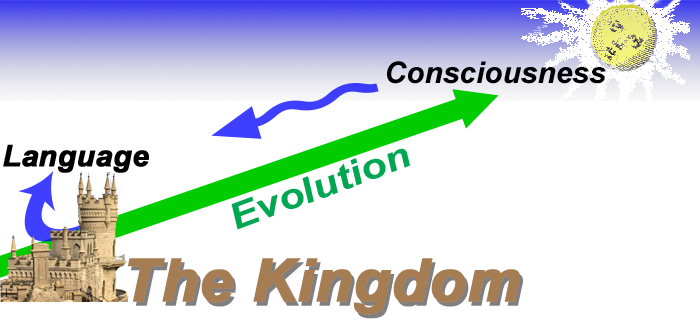
It makes sense that for our distant ancestors, "The Kingdom" had to be up and running before Language developed, so our Language layer learned most basic words from the Kingdom, and rarely any from the Child-King.
Language as OS
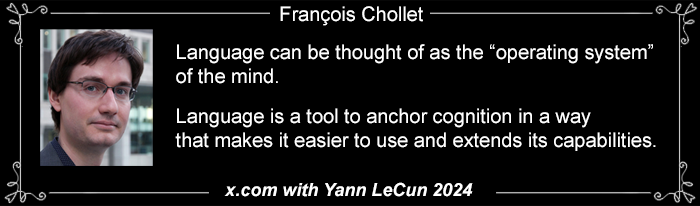
In their discussion, both Chollet and LeCun clarify that thought is possible without language, as exemplified by people who lose the ability to speak and yet otherwise function intelligently. But original Language acquisition is critical and determines the clarity and precision of thought.
"When the child begins to communicate by speech, and to practice speaking, he starts on a line of development that makes his knowledge of the world forever different from what it would have been if he had remained a speechless animal."
— Gibson
For a digital computer, the Operating System (OS) provides an important bridge between the software and hardware layers. It can do this through a series of "managers" which provide layers of abstraction. The "manager" approach allows the same software to interact with various hardware configurations, even if the software was written before the hardware existed.
Since many humans speak multiple languages, the actual "OS of the mind" version would be an abstraction of language itself. A sort of Universal Grammar layer, that runs instances like "English" or "Italian." All languages [1] need some way to represent Nouns, Verbs, Adjectives, and Adverbs. This is one of the unexpected discoveries that came from developing ARCHIE. These four categorical functions are required to solve ARC puzzles. Chollet developed ARC puzzles to function as a sort of IQ Test for human and non-human intelligence. But any creature navigating an environment needs to discern objects against a background, note differences between instances, and detect changes over time. "Proto" Universal Grammar seems to originate in the primitive visual system designed for determining cause and effect.
Within the context of grammar, words have meaning and become placeholders for the values being processed during thought.
The Kingdom Calculates; the Child-King Computes
Detecting objects against a background, detecting similarity amongst objects, detecting actions initiated by objects, and detecting various magnitudes among actions; these all form the building blocks for a "Proto Language." The most important step is detecting Objects.
If we don't start assigning attributes to objects and just treat them as abstractions, we can pivot from 'Proto Language' to 'Proto Mathematics.'
The human brain can keep track of up to four different objects with its OTS — Object Tracking System. The OTS is common to the brains of other species, not just mammals, but birds and fish as well. It is a highly conserved mental function, and the limitation appears shared as well.
When the number of objects grows beyond four, another system — the ANS (Approximate Number System) takes over. This brain function is also conserved across species, and determines whether one group of objects has more elements than another. But detection only works if the difference between the group sizes is significant. The ANS cannot determine precise quantities.
Without the ability to determine quantities beyond four, there is no ability to do math. This limitation is shared across the animal kingdom, and the OTS and ANS are shared with the Kingdom portion of our minds. Is a Child-King required to do math?
To manipulate quantities above four precisely requires a technique we call COUNTING.
At the most basic level, counting requires the representation of an object with a kind of abstraction we call 'number.' Children are taught to learn numbers by reciting a sequence of sounds (words). Each of the words is unique. If you match a word uniquely to each object in a collection, the last word associated with the last object is the total quantity! This bypasses the brain's limitations of the OTS and ATS. It provides a single precise thing to remember — a sound.
So does counting require language? Not really.
Keeping a Tally
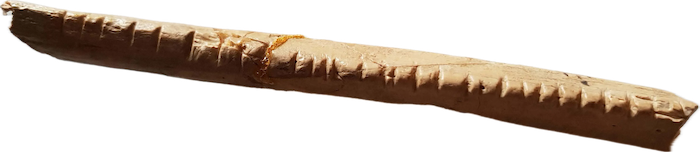
40,000 years ago, someone carved tally marks on this bone.
The Lebombo bone (image above) has notches that were carved on separate occasions. One theory is that a new notch was made during each night of a lunar cycle. The same technique could be used to record new lambs as they are born into the herd. In any case, a TALLY is a sequential way of recording a growing quantity of objects. One tally mark for each object.
Tallies have been kept as a counting technology for millennia. Aside from adding notches to sticks or bones; creating impressions in clay or adding knots to cords serves a similar purpose. Tallies build and then record a total quantity. Instead of answering a question about "how many" with a mutually agreed sound (word), a tally provides a purely visual representation of the answer — no shared language required.
The limitation of a Tally becomes apparent when handling large quantities. Each new mark extends the length of the recording Tally until it becomes impractical to continue. What is needed is a different type of mark that represents a "bundle" of single tally marks (which, in turn, represent individual objects).

If this challenge reminds you of the Roman numeral system, you would be right!
The Chimp Test
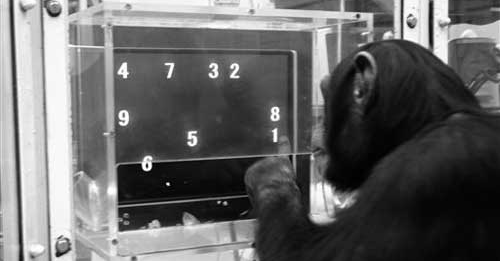
Chimpanzees outperformed college students in sequencing Arabic numerals.
A 2007 experiment in Japan revealed that chimpanzees outperformed humans on a "limited-hold memory task." Specifically, the study "shows that young chimpanzees have an extraordinary working memory capability for numerical recollection better than that of human adults".[2]
The experiment involved a touchscreen that randomly positioned a series of Arabic numerals. The chimps were first trained in the sequence of the numerals — 1 through 9, and after mastering the full sequence, they were later presented with discontinuous subsets (e.g., five of the nine symbols). At this point, both humans and chimpanzees could successfully touch each numeral in order.
The important part of the study came with the "masking task." After the first numeral was touched, a white square would block out each of the remaining digits. To complete the touching sequence, the subject needed to remember each placement. The chimpanzees were somewhat better than humans at this. Then came the "limited-hold memory task." Here, once the task started, the numerals would appear for as little as 210 milliseconds and then be replaced by the masked squares. 210ms is such a short duration that the brain has to perceive the total image in one shot; there is no time for any eye scanning to occur. Under these conditions Ayumu, the top-performing chimpanzee, scored about 80% accuracy, compared to an average 40% accuracy among the human subjects.
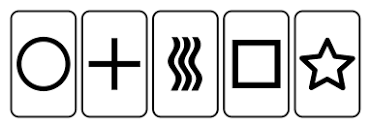
The misleading aspect of the 'Chimp Test' is that it represents numerical accuracy. I have purposely avoided referring to the sequenced symbols as 'numbers,' although the human participants probably thought of them as numbers. For an educated human, it is difficult to see Arabic numerals and not internally hear them as "one, two, three...". For the chimps, they are just symbols that have a sequential order, "this, and then this, and then this...". A more neutral selection could have been something like the symbols used on ESP cards:
 ...
I don't think the symbology was selected to prove an exaggerated claim about chimpanzee mathematics. For the computer display, the Arabic numbers were probably easier to program. While the chimps would require a lot of training regardless of the symbol set, the humans would need no prior training with Arabic numeral sequencing.
This association with numbers is a huge impediment for humans during a 'Chimp Test'. They briefly see an image with symbols; the brain wants to convert these into words, and then match the words to a memorized sequence. On the other hand, at first glance, the chimpanzees began tapping into unconscious navigation: Go here, then here, then here, then here...[3]
The researchers specifically mentioned the chimpanzees's superior visual memory. Ayumu's performance degraded only slightly as the display times decreased. Not so for the humans. There is also a component of 'episodic memory' at play as well. I wrote about this and the 'memory palace' in Kingdom of Mind PART SIX. The memory palace technique significantly enhances sequential (episodic) memory by visualizing travel from place to place, rather than trying to memorize words from a list. Utilizing our metaphor, the hard-wired Navigation of the Kingdom outperforms the language functions of the Child-King.
Finger Counting
Adding single elements or taking them away from a larger collection is a very crude approximation of arithmetic. In ancient Greek, 'arithmetic' translates as 'the art of counting.' So we are still on the right track.
Carving tally marks is an easy way to add to a count, but tends to be permanent. For a convenient way to add or remove elements from a (non-verbal) total, finger counting continues to be the solution at hand.
With the 'digits' of both hands, quantities up to 10 can be represented. This is credited for our base-10 numbering system. One way to think of a base is to have a small set of representative symbols (or fingers), and once you cycle through all of them, you increment a symbol in some sort of COLUMN next to them.
5,000 years ago, the Sumerians utilized a base-60 number system. This is why we still have 60 minutes in an hour, 60 seconds in a minute, and 360 degrees in a circle. What may come as a surprise is that you can count to 60 without any use of language.
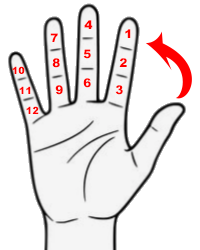
Take the thumb of your right hand and touch the top segment of your pointing finger (marked as 1 above). Then move your thumb to segment 2, and then to 3. Using your thumb to divide your fingers into thirds quickly feels natural. When you get to the base of your pinky, extend one full finger of your left hand. Go back, and with your right hand, cycle through the twelve segments again and put out a second finger from your left hand. If you follow the pattern of sequencing 12 segments and then extending a finger on the opposite hand, when all fingers (and thumb) on your left hand are extended, you will have reached 60.
It's worth taking a few minutes to work on this right now. If it helps, you can start by verbally counting as you sequence the segments, but your goal is to have both hands automatically sequence this motion. It's a very natural pattern, and very soon you will find yourself counting "automatically" from 1 to 60.
Although we can count to 60 with this method, it's really the beginning of base-12 counting. This is because, after we cycle through all 12 finger segments, we use a finger from the other hand to represent the completion of another cycle. With only 5 fingers "in the second column," our count is halted at 60. If we were to implement base-12 properly, we would use all 12 segments of the left hand, too, keeping track of right-hand sequences. In this manner we would end up counting to 144 (12 x 12). The important takeaway is that a major breakthrough in numeracy — the positional base technique — can be implemented with non-verbal finger counting.
Counting Boards and the Abacus
The word 'calculation' derives from the Latin 'calculus,' meaning small stone or pebble. Counting boards were an early math technology that, like the abacus, performed addition and subtraction by counting and moving groups of pebbles. The series of calculations (pebble movements) keeps track of a running total for the user. The total can be read at the end of the series. Finger math is also a method of calculation, as it utilizes external tracking during the counting process. Pebbles and fingers (digits) become an extension of numeric memory, a level beyond counting.
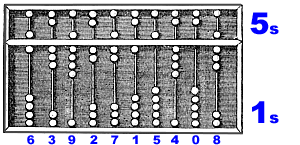
Chinese 'suanpan' 算盘, literally "calculating tray"
I always thought the Chineese abacus was mysterious and would be complicated to understand. Actually it's really easy! And it represents a stepping stone from counting to calculating.
What you see above is an abacus configuration representing the base-10 number 6,392,715,408. Each column represents a single digit, and it's read left to right, just like you're used to. If you look to the far right (in the 1s place), we can see how the bead positions represent the number eight: The bottom section has 3 beads moved up to the divider, so that part is 3. The top part has one bead moved down to the divider, so that part is 5. 5+3 = 8. That's how it works!
If you shift one column to the left, you can see all beads in a reset position (none are touching the divider), so that's zero. Take a moment and look at each column and confirm that the bead positions match the blue Arabic numerals I placed below them.
The utility of a 'calculating tray' comes from facilitating arithmetic. Let's add 25 to the configured tray above.
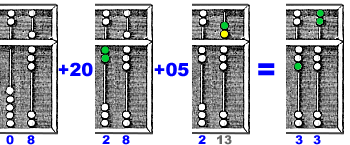
Abacus addition is just moving pebbles...
We take one digit at a time to add 25 (+20, then +5). You can do them in any order. Let's start from 20 just to be different from how we would do this with a pencil and paper. To add 20 to the abacus, we move 2 beads up in the 10s column. To add 5, we move one 5 bead down in the 1s column. If all the beads on either side end up against the divider, we "carry" the value over to a single bead in the next-highest section. So when two 5-beads hit the divider, we move a single bead up in the column to the left and reset both 5-beads to the top. The illustration shows how 25 + 8 = 33.
Subtraction works the same way, but by moving beads in the opposite direction. Multiplication works without the need to memorize any tables! A problem like (3x8) breaks down into what is literally being asked: Add 8 to the total 3 times. All done again by just moving pebbles (or sliding beads).
Other abacus configurations exist, and a simpler version just has 10 beads in each column and no second section. That would be even easier to learn on paper, but creates a long string of beads that are slower to manipulate. The classic Chinese version above is called 2 over 5, and is still in commercial use today in Asia.
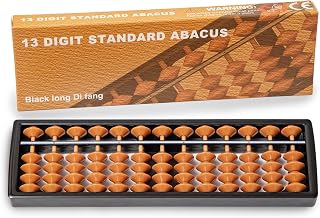
There is movement to teach children superior math skills through "Abacus Mental Math." They begin with a physical abacus and then automate the skill through mental imagery and hand gestures. You can buy a "Professional Standard Abacus" that they would use, configured 1 over 4. The smaller dimension still fully supports base-10 arithmetic, and recognizing four beads (instead of 10) fits better with the brain's built-in Object Tracking System (OTS).
Human Computers
We have reviewed the skill levels of Object Recognition, Object Tracking, Counting, and then Calculating. The first level is required for all visual creatures; the next level is shared by most of the animal kingdom. Counting and Calculating seem to bridge the gap between what most animals can't do and what our own mental Kingdom can learn to do.
The level above Counting and Calculating is 'Computation.'
Understanding the requirement set for 'Computation' is critical. It defines a boundary between the Kingdom's and Child-King's contributions to cognition.
But first, let's check a counter-argument.
"Which physical systems perform computations? According to pancomputationalism, they all do. Even rocks, hurricanes, and planetary systems — contrary to appearances — are computing systems. Pancomputationalism is quite popular among some philosophers and physicists."
— Stanford Encyclopedia of Philosophy[4]
Let me be clear. I utterly reject pancomputationalism.
The argument in favor of pancomputationalism will generally involve "The Universal Turning Machine" and somehow infer the Universe is a Turing Machine. There is also an assumption that Turing invented 'The Computer', and therefore 'Computation.' Because, they argue, computation can be trivially defined as what a computer does. This is all wrong.
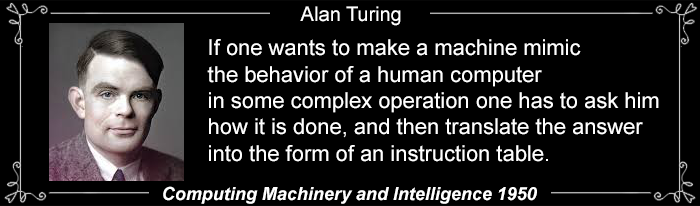
'Putare' is the Latin root of the word 'compute.' It means to prune or simplify. Long before Turing's time, a "computer" was a special human being who performed the task of simplifying an account, which may contain many individual calculations. Computation requires consciousness and is not something performed by the Kingdom, other species, and especially not rocks.
“To me, computation is a description of a teleological process - it has states, and rules for manipulating, interpreting, and reacting to those states, and it benefits itself by following those rules.”
— Malcom Lett
Super-powers shared by the Kingdom and other species derive from Navigation and Geometry. The Child-King brings the power of Computation. This means a problem can be broken down into component sub-problems and then reassembled into a simpler whole at completion. This is a level-up from Navigation, where a goal destination has "stepping stones" like "here, and then here, and then here...". Building components differs because it can be done asynchronously. Navigation requires that all interim destinations appear in order. Doing things out of order requires a good method for planning and tracking progress through a memory structure.
Turing's "Machine" introduced a tape with cells onto which interim results were recorded. He got this from watching how human computers performed complex operations. They write down their progress as they go and use different methods based on the outcome of results. His statement above is the key to the paradox of why "the hard things are easy." When the hard things are performed by the Child-King, one merely has to "ask him how it is done."
In PART FIVE, Conversing with the Child-King
You can leave thoughtful comments or questions at the link below.
1. There are many ways to represent this functionality in spoken language, often through direct modification of nouns or verbs themselves. Suffixes, prefixes, intonation etc., may all be used as object or action modifiers. Even if a language spun up a completely different word for every noun variation, the conceptual meaning would still exist and the variations would still be modifiers.
2. "Working memory of numerals in chimpanzees" 2007. Sana Inoue, Tetsuro Matsuzawa. Current Biology Vol 17, Issue 23.
3. You can test yourself with an online version of the Chimp Test. Advice for better human performance is to mentally recognize the visual stimuli as a path to navigate, rather than numbers to be sequenced. Online Chimp Test
4. "Computation in Physical Systems" Stanford Encyclopedia of Philosophy, 2025