Keys to the Kingdom PART FIVE
Consciousness is the least important function of your brain

November, 2026

Previously on Keys to the Kingdom...
In Part One, we expanded on the Kingdom of Mind metaphor. I defended its validity based upon the science behind Embodied Cognition.
In Part Two, we revisited Moravec's Paradox and how classic AI defeated Human Champions at everything — no artificial Neural Networks required.
In Part Three, we saw how Theory of Mind causes us to project understanding onto things that can't comprehend meaning. This is known as the "ELIZA EFFECT."
In Part Four, I claimed that consciousness is not the true source of meaning and that our Language layer learned most basic words from the Kingdom and hardly any from the Child-King.
Conversing with the Child-King
It may seem paradoxical to talk about, and around, the Child-King. My Child-King is talking to your Child-King, but even this is not a direct route. My Child-King is dictating the narrative I am recording, and your Narrator is reading it to your Child-King. A Child-King never has privacy, and others in the Kingdom are always listening. Your Kingdom should be thrilled to be recognized for all its critical contributions. Freud's darkly sexualized and violent layer of the Id is not an appropriate characterization. Yes, there are criminals within any Kingdom, but they are a tiny minority. The Kingdom is a highly functioning society.
Being a child, the Child-King has a level of insecurity, and being a king, it's naturally imperious. The Child-King can mature to become a good king or a tyrant. The relationship between a King and the Kingdom determines which.
The Child-King is not a free-floating spirit, attaching itself to your cells at conception or emerging later as epiphenomena. The Child-King is a biological product of evolution. Consequently, it is influenced by instinct and seeks the companionship of others like it. This makes it vulnerable to "Theory of Mind" exploits provided by some AI Chatbots. The Child-King can become lonely and be led astray by other human beings or by substances that act as "demons." These influences usurp the Child-King's agency. A Child-King with a disharmonious relationship with their Kingdom can be easily persuaded to engage in self-destructive behavior. But if you have a Good-King that truly loves your Kingdom, this will not happen.
Hidden Persuaders
In 1957, James Vicary claimed to increase Popcorn sales by flashing an image of "Eat Popcorn" during a movie. Vicary later withdrew his claim, saying it was only a "gimmick" to increase interest in his marketing business. Nevertheless, in 1958 and 1959 two congressional bills were introduced to ban subliminal advertising. Both died before being voted upon.
In 1958, the CIA created a report "The Operational Potential of Subliminal Perception."
Interest in the operational potential of subliminal perception has precedent in serious consideration of the techniques of hypnosis, extrasensory perception, and various forms of conditioning. By each of these techniques, it has been demonstrated, certain individuals can at certain times and under certain circumstances be influenced to act abnormally without awareness of the influence or at least without antagonism.
— Declassified CIA Report [1]
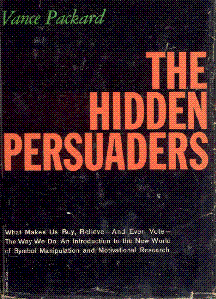

The Hidden Persuaders (1957) Subliminal Seduction (1974)
Internet sources will suggest that subliminal influences don't actually work and would be illegal if they did. However, the CIA actually concluded, "there are so many elusive variables and so many sources of irregularity in the device of directing subliminal messages to a target individual that its operational feasibility is exceedingly limited."
For us, what is interesting here is not a specific targeting technique, but rather that a conversation can be had with the Kingdom, unbeknownst to the Child-King. The CIA was disappointed it couldn't reliably command the Kingdom as the Child-King does. That's a good thing. However, I introduced this so you may consider what other conversations the Kingdom may be be having outside of your conscious awareness.
A subliminal influence, by definition, cannot be consciously detected, despite actively watching for it. A supraliminal influence is detectable but is not considered important at the time. Marketing firms currently consider supraliminal advertising a 'fair game' technique. A famous example influenced whether German or French wine was selected in a UK supermarket by playing either German or French music in the background[2]. The Child-King could hear the music but was completely unaware it was influencing the selection. Another agent of the mind was paying attention, though.
The Stack of Consciousness and the Royal Court
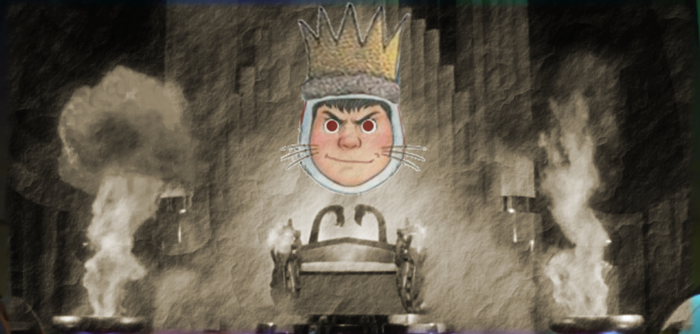
"Behold, I am the Great and Powerful..."
One of the more elusive aspects of Consciousness is that it is not a singular thing but rather a stack of "royal agents." The stack can become larger or smaller, and the Child-King will claim total identity of the stack. For the purpose of our metaphor, it would be useful to think of Consciousness as the assemblage of the Royal Court at any particular time.
Consciousness seems mysterious because people want to include any and all of the Royal Court as suits the point they want to make. They will accept the notion of "diminished consciousness" without considering this could be due to a reduction in the Royal Court. The most radical view, and the hardest to accept, is that the Child-King might not always be present. That 'self-awareness' may be a trait for many agents of the mind, with deference given to the Child-King when present.
Much of what I wrote in "Kingdom of Mind" was to establish a case for the modular nature of Consciousness. I also supplied the "basic stack." Again, it looks like this:
- The Child-King — Sovereign Speaker and Executive Problem Solver
- Spotlight Awareness — Focus Selector for Incoming Information
- The Spectator — Initialized Character of "I." Maintains Orientation of Time and Place
- The Recorder — Scribe for Ongoing Events
Some of the optional agents identified in "Kingdom of Mind" include:
- The Wizard — Conjures Visual Imagery
- The Orator — Produces Internal Speech
- The Narrator — Verbalizes Symbolic Messages
- The Minstrel — Plays Internal Music, both Wanted and Unwanted
- The Historian — Looks Up Past Episodes
- The Librarian — Provides Learned Facts
- The Advisor — Seemingly External Verbal Council
Altered Level of Consciousness (LOC)
Severe non-responsiveness — missing pupil response or gag reflex indicative of coma — is a problem at The Kingdom level. At the other extreme, if you are not currently hearing music in your head, no one would consider this diminished consciousness.
If you can't answer basic questions about your current time and place, you are clinically "confused." Disorientation comes from a malfunction of The Spectator. Conversing about it requires the Child-King. Since orientation is critical to navigating in the world, I will assume most of the animal Kingdom also has some level of functioning Spectator.

Noticing the mark during a "Mirror Self Recognition Test"[3]
During the "Mirror Self Recognition Test," a creature is familiarized with its own image in a mirror. Usually while anesthetized, a mark is placed on the creature's body in a prominent place. Later, the creature is shown its image in the mirror again. If it pays attention to the mark and tries to remove it, this is considered evidence of self-recognition, the first level of self-awareness. (Leaving the mark alone is not evidence against self-recognition; there may be other reasons.) As expected, many primates "pass" the test, as do elephants, dolphins, killer whales, and other notable "big brain" animals. But also passing the test are some birds, fish, and even ants. This provides more connection between the minds of other creatures and the Spectator in our own consciousness stack.
Goldfish are supposed to have memories of only a few seconds. This turns out to be a myth, along with the claim that chimpanzees forget within 20 seconds. Justification is based on a type of abstract experiment intended to test episodic memory (e.g. 'this happened and then this happened and then this happened...') as opposed to semantic memory (e.g., 'food is here'). Experimenters focus on the "delayed matching-to-sample" (DMTS) of abstract shapes that would be meaningless except to humans. What is ignored as evidence of episodic memory is a creature's ability to remember navigating complex paths. Capturing episodic memory is the primary role of The Recorder, although new facts also have to be recorded.
An outstanding demonstration of The Recorder takes place under the drug Versed (midazolam). Versed is frequently used during colonoscopies and allows the patient to present an illusion of complete functionality, while at the same time experiencing anterograde amnesia. The patient is calmer, less inhibited, compliant, and won't remember a thing about the procedure! They can still converse fluently, although the loss of short-term memory means they may repeat things that were recently asked or said. Under Versed, the Recorder is 'on a break' although the Child-King can be chatting away.
Uniquely Human?
Bringing up examples of Royal Court members found in the rest of the animal kingdom may seem like I am dismissing unique features of the human mind. I do propose that the Child-King's advanced problem-solving and computation are unique to humans. I also propose that an interaction of the Spectator, the Recorder, and the Historian allows us to create stories about ourselves. Of course, the Child-King claims this is all about the Child-King. I'm not sure of the evolutionary benefit for this specific ability. Perhaps it's related to stabilizing positions in a dominance hierarchy? If so, some animals may also create stories about themselves, but without a shared language, this could be very hard to detect.
Otherwise healthy humans can cling to tragic stories they've created about themselves. This can result in downstream mental issues. If you have an unfavorable narrative of yourself, realize that this involves the interaction of relatively few agents. Other agents of your mind can be recruited to narrate a more positive story.
In PART SIX, Use Your Head, Follow Your Heart, Listen to Your Gut.
You can leave thoughtful comments or questions at the link below.
1. "The Operational Potential of Subliminal Perception" 1958. Declassified CIA Report.
2. "The Influence of In-Store Music on Wine Selections" 1999. North, Hargreaves, McKendrick. Journal of Applied Psychology Vol 84, No.2
3. "Are Ants Capable of Self Recognition" 2015. Marie-Claire Cammaerts and Roger Cammaerts. Journal of Science Vol 5, Issue 7