Keys to the Kingdom PART SIX
Consciousness is the least important function of your brain

November, 2026

Previously on Keys to the Kingdom...
In Part One, we expanded on the Kingdom of Mind metaphor. I defended its validity based upon the science behind Embodied Cognition.
In Part Two, we revisited Moravec's Paradox and how classic AI defeated Human Champions at everything — no artificial Neural Networks required.
In Part Three, we saw how Theory of Mind causes us to project understanding onto things that can't comprehend meaning. This is known as the "ELIZA EFFECT."
In Part Four, I claimed that consciousness is not the true source of meaning and that our Language layer learned most basic words from the Kingdom and hardly any from the Child-King.
In Part Five, we explored the paradoxical nature of conversing with the Child-King, and also with The Kingdom.
Use Your Head, Follow Your Heart, Listen to Your Gut
Western education is largely about learning to "use your head." This entails making rational decisions instead of reacting emotionally. The root concept behind "rational" is "ratio," which means thinking about things in terms of comparative quantities. A ratio facilitates conclusions by comparing values. The relationship between 2 and 4 is the same as between 3 and 6. Both represent one half. Ratios allow you to scale solutions across increasing or diminishing quantities. When mixing quantities of water and cement, knowing the ratio is critical for making concrete. Rationality is a "level up" from the fixed quantities used in counting or calculation.
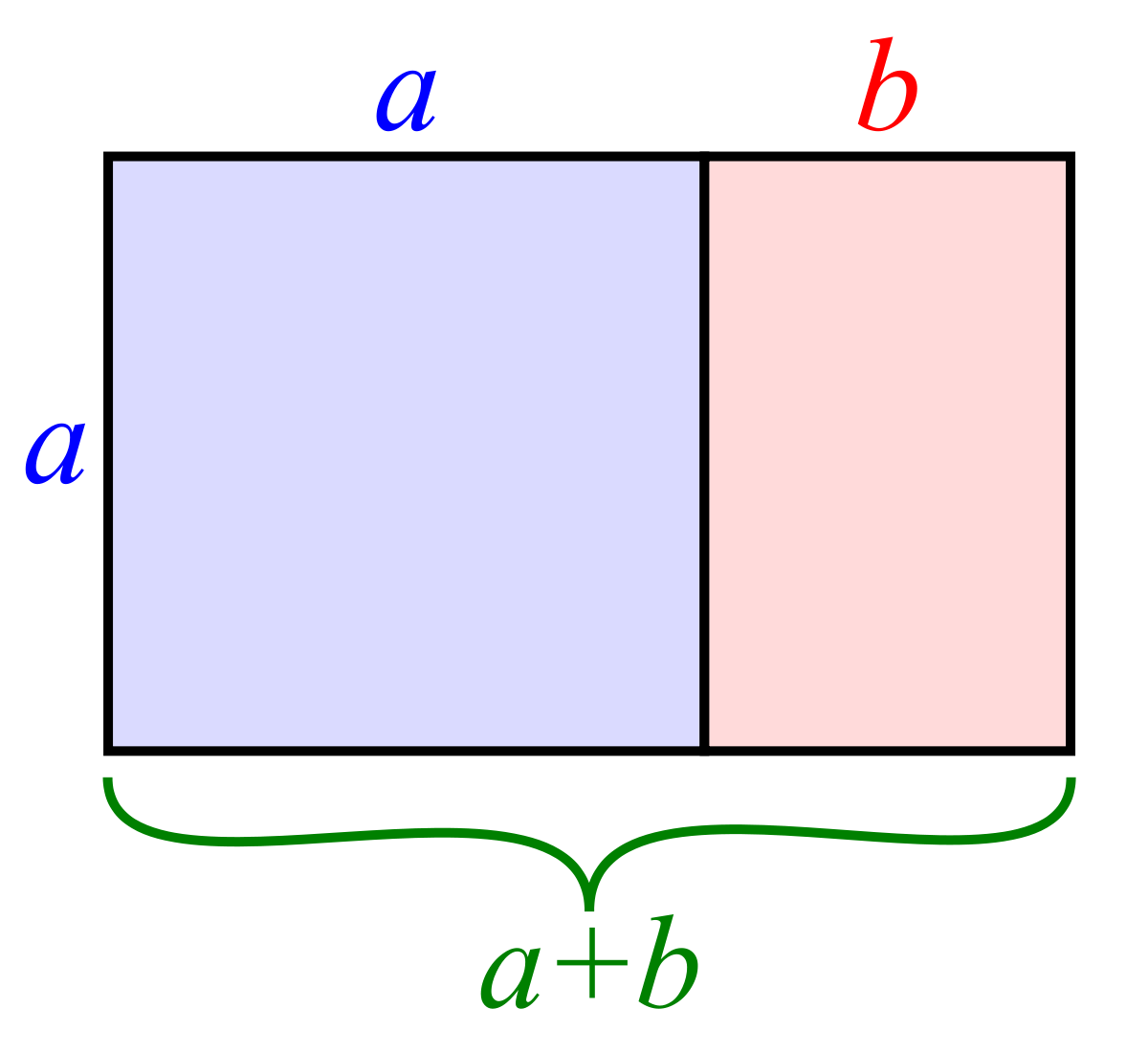
The 'Golden Ratio' adds self-reference: A is to B what A+B is to A
Logic is another rational technique for comparing values. It actually supplies an additional dimension in the form of a 'logical operation.' For the statement "P AND Q" to be True, P must be True, and Q must also be True. However, if we say "P OR Q," then either or both can be True. There are multiple logical operations that combine to provide guaranteed valid conclusions.
Reason is sometimes equated with rationality and logic, but actually it is an encompassing faculty of the mind. It utilizes those rational techniques but has a larger goal of finding fairness and truth. There are true conclusions hidden by the strict techniques of rationality. Reaching these truths requires input from other parts of the Kingdom.
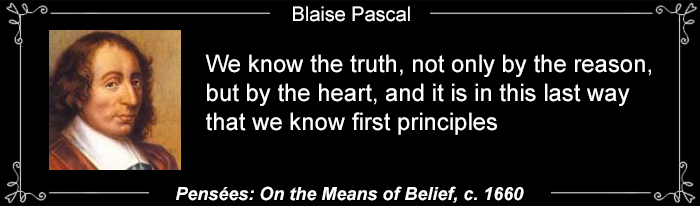
Pascal is remembered as a genius mathematician and important scientist. The Pascal programming language is named in his honor. His quote above is from a posthumous publication of his "thoughts" on the importance of religious revelation. In his terminology, however, he conflates the terms 'reason' and 'rationality.' His criticism of "reason" — that it does not follow "the heart" — is the very distinction we now make between the two words. Pascal's "first principles" are "intuitions of the heart" and are not produced by Reason. This corresponds to my earlier point: "Consciousness is Not the True Source of Meaning."
“The knowledge of first principles, such as space, time, motion, and numbers, are as sure of any of those, which we get from reasoning. Reason must trust these intuitions of the heart, and must base them on every argument.”
— Blaise Pascal
Listen to your Gut
If your Head is about thoughts, and your Heart is about emotions, what is happening in your Gut that involves "listening?"
When asked about "thinking," it seems to be some process happening inside your head. The location may be a cultural choice, but we recognize "thinking" as distinct from "feeling." We can feel a cool breeze or the sun's warmth on our skin. We feel sore muscles. But we also "feel" happy, or angry, or love. The experience is related to our physical senses and not connected to a mental simulation, like it is with "thinking." Emotions seem connected to our body in particular. The Child-King is copied on input from our physical senses, so it seems, at a high level, emotions utilize the same communication path.
However, when we say "listen to your gut" or "I have a gut feeling," both reference something very different from the gurgles of a bellyache. The input from our gut is really a reference to instinctual input. Instincts are more sophisticated than just genetically programmed facts, like "spiders are scary." If we consider "duckling imprinting," there is a procedure (determine the first moving object) coupled with a variable (mother) to form a critical attachment. We don't know the schedule of our own developmental procedures, and because their outcomes are variable, we probably classify a lot of our instincts as simply learned behavior.
Instincts don't have the same bodily communication channel as emotions. There can be vague crossovers, like an "uneasy feeling in my gut." But the advice to LISTEN to our Gut carries an interesting connotation. Because we are not listening for sounds from our physical gut, but rather for VOICES from our instincts.
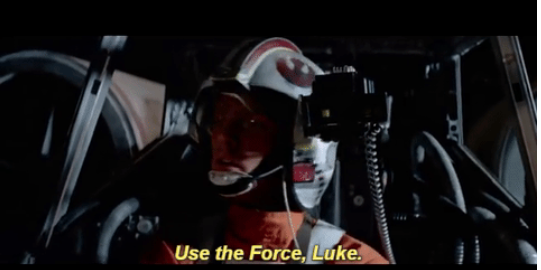

"Let go your conscious mind..." "Trust your instincts. Don't think. Just Do."
In Star Wars, Luke believes he is hearing the disembodied voice of Obi-Wan. In our Kingdom of Mind model, the voice is real and is coming through The Advisor. This vocal advice is an important communication path between Instincts and the Child-King. It is also noticeably "other" than the inner voice of The Ortator who practices speech for the Child-King. It can seem like a spooky external voice. But all this is still happening within the same mind. No paranormal entities are involved.
Star Wars and Top Gun both feature pilots who are advised to bypass "consciousness" and listen to their instinct. The "life or death" activities they are engaged in require a reaction time that can't be handled by conscious thought. The Child-King is a marvelous problem solver, but the process takes far too long for high-intensity action. Shifting physical reactions from conscious to autonomic control is required in many sports, not just combat situations.
Voices in your Head
Taking orders from another "voice in your head" plays a huge role in the theory behind "The Origin of Consciousness in the Breakdown of the Bicameral Mind" by Julian Jaynes. Jaynes argues that in the recent past we had two competing speech centers, one in each brain hemisphere, and the commanding gods of ancient literature spoke from one of those. That's my comic book summary of his substantial work, but it anchors the presence of a seemingly external voice in the human brain. In modern times, we discourage hearing other internal voices, and discourage even thinking about listening to one. The practice has only survived as "listen to your gut."
A voice relaying instinctual wisdom to the Child-King is an important addition to decision-making and overall survival. But it's important to remember that the Child-King is a product of evolution. If the "Voice of Instinct" were adequate for survival, there would be no Child-King at all. Instinct can be deadly wrong. Emotions can be deadly wrong. So a Child-King was anointed. A good King will take councel from these older sources of wisdom, but he will not allow them to run the Kingdom unsupervised.
In the CONCLUSION, we examine the integrated mind as the way to pursue expertise in life.
You can leave thoughtful comments or questions at the link below.