Philosopher Stones
Not All that Glitters

August, 2024
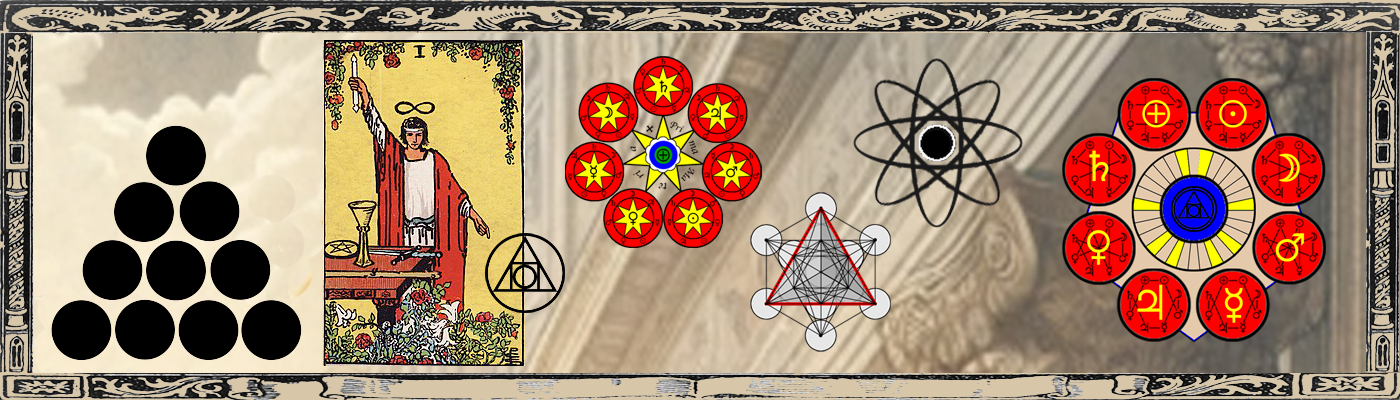
Uncovering Divine Symmetry
Until I stumbled across Isaac Newton's unpublished writing on Alchemy, I really had little interest in what I considered a failed pseudo science. The Philosopher's Stone seemed like other mythical objects that have a basis in human desire, but not in reality. There is an actual Boundary of Objectivity, and I believed history had sorted the Philosopher's Stone irrevocably to the subjective side. Alchemy is pursued today only as "spiritual alchemy."
In "The DaVinci Code," Dan Brown asserts "The Quest for the Holy Grail" was NOT the search for a golden drinking vessel, but rather a hunt for a Divine Personage. (You may find the book considerably more interesting than the movie.) Brown brings up a lot of occult European history and correctly points out ways in which alternate religious views are necessarily hidden in plain sight.
Occult just means hidden, and when you become aware of objective ideas that have been purposely hidden, you can start to see them more easily. You can also become less critical in your thinking and start to see larger, conspiratorial patterns that are not real. This Epiphany/Apophany bifurcation is the basis for my article "Pareidolia."
Conspiracies are less likely to be real because they require continued secrecy by more than one person. Conspiracies seem to work only when everyone involved would lose something by their discovery, and anyone who uncovers them somehow joins in the loss. Occult items, on the other hand, are usually encoded by a single author who wishes dual meaning in a creative work.
Single substitutions of one meaning for another can be difficult to detect. However, when multiple substitutions have been made, our mind may begin to detect a pattern, and the pattern is even more easily detected when we perceive symmetry. The earliest scientists conceived of God as the author of the Cosmos, and He "signed" his work with meanings specifically useful for Mankind. The goal of science was to discover these signatures in nature. While this may seem droll to the modern clever atheist, Carl Sagan's conclusion in "Contact" was that the "Creator" has left an incontrovertible signature within complex numbers. So the search is ever the same.
Overdetermination
Sometimes multiple causes align around a single effect. In the case of the "Philosopher's Stone," I believe several quests evolved around a single term. The first, and to me most obvious, is the quest resolved by Hennig Brand in the late 17th Century. The term "Stone" seems to reference a slab of rock, the type in which an Arthurian Sword would be embedded. But when "Stone" is mentally associated with "Kidney Stone" or "Bladder Stone," its meaning shifts to a concretion within the Philosopher's body. And suddenly, all the references to the body as the "microcosmos" and the statement that urine has "the hardness and nature of a stone" leads to the realization that it was "white phosphorus," not the transmutation of gold, that was the original goal. ("Hardness" of urine refers to high mineralization, a term still used today when referencing "hard water"). I give a more comprehensive account in "Comprisation - Magnum Opus."

The Last Alchemist and the Second Stone
So if "fire artist" Hennig Brand decoded the occult mystery surrounding white phosphorus, what were great mathematicians like Newton and Leibniz doing with diagrams like "Ancient Chaos" and "De Arte Combinatoria"? These represent something very different from a secret recipe. They are the beginning of a comprehensive approach to discovering "divine symmetry."
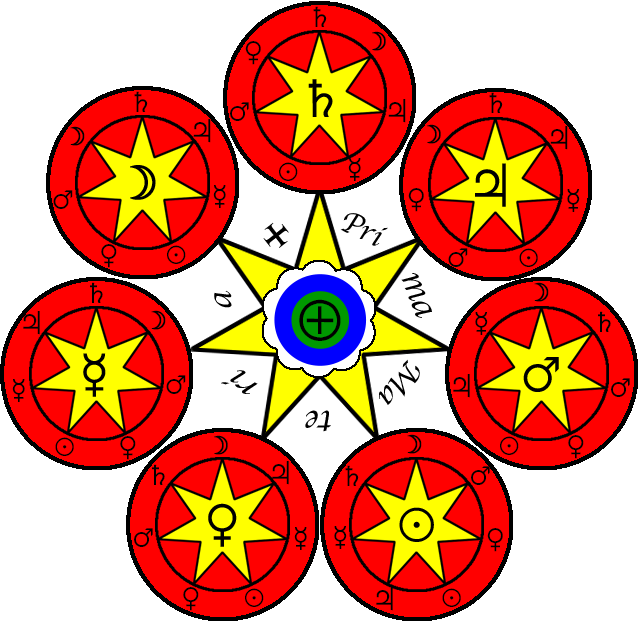
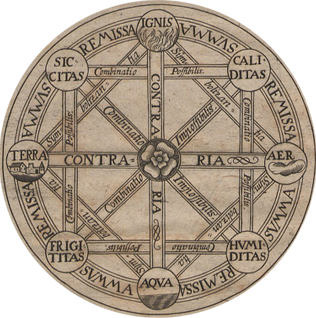
Both diagrams start with a set of "prime elements" and propose a way to combine them comprehensively. "Ancient Chaos" has a seven-fold symmetry, rotating around the "Prima Materia" or Prime Material. The Leibniz Combinations involve the four Classic elements and the four Classic Qualities. By ordering the Elements along a "Cold - Hot" and "Moist - Dry" arrangement, the scientific "four fundamental states of matter" emerge. More was covered in "The Elements."
I previously wrote that the "Fire, Water, Earth, and Air are not taught in public school, relegated to Mystical and Occult studies only." This is true. But the Four States of Matter are taught, and so it really wasn't a dead end after all. The Aristotelian Elements turned out to be scientific, referring to elemental states of matter, but not elemental forms of matter.
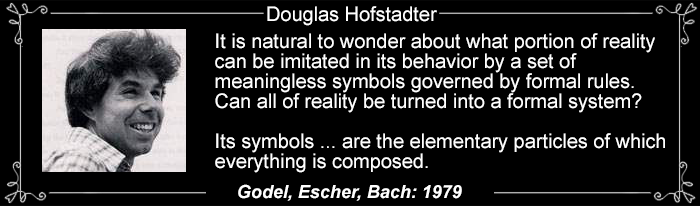
The notion of "formal systems" became more "formalized" in the 20th century. But the structure of a finite set of starting elements (axioms) and the rules governing their interaction is already present in these diagrams. I think these specific diagrams also add something distinctive and important — periodicity.
Normally, the elements and rules are presented in a list form.
Euclid's Elements (Axioms of Euclidean Geometry c 300 BC) :
- A straight line segment can be drawn joining any two points.
- Any straight line segment can be extended indefinitely in a straight line.
- Given any straight line segment, a circle can be drawn having the segment as radius and one endpoint as center.
- All right angles are congruent.
- Through any given point not on a line, there passes exactly one line parallel to that line in the same plane.
This is the type of list you can expect when presented with mathematical or scientific axioms. What's defining in both the Newton and Leibniz diagrams is that they are CYCLIC, COMPREHENSIVE, and FINITE. They are attempts to describe the entire Universe, and not just one aspect. They declare the most basic elements and define the relationships between them. Their structure is Cyclic, because observation of the Heavens shows the Cosmos is Cyclic. As Above, So Below.
Periodic is Cyclic
Aristotelian Elements resulted in the Four States of Matter. Hard work in seeking the Prima Materia of Alchemy led to the Periodic Table of Elements. I discuss this connection in the conclusion of "The Elements."
The secret to our modern understanding of chemistry and the atom came from atomic weights. By arranging chemical elements by weight, and by inference, their count of protons and electrons, a definitive pattern of their behavior emerged. It provided both the knowledge and the theory of what happens when you combine one element with another. And yes, it even provided the method for turning a base metal into Gold, albeit through nuclear rather than mere chemical interaction.
We had two competing views of what constitutes the universal Elements: Aristotelian, which led to states of matter, and Atomic, which led to chemistry. If we remember back to "The Elements," there was an additional model of the cosmic elements, that of the Pythagoreans. They believed, in a very deep and religious sense, that the universal primal elements were NUMBERS.
Go Ask Alice
Before the rabbit hole of alchemy, I was working on Prime Numbers from a very data-driven, bottom up approach. I was not trying to follow some graphic pattern to see if a Prime Number generator could be fit to it. I'm glad I didn't, because anticipating the eventual structure would not have led to its actual form. The 'Prime Clock' diagram came from the numbers themselves, and seeing the resemblance to the 'Ancient Chaos' in Newton's notes came as a shock.
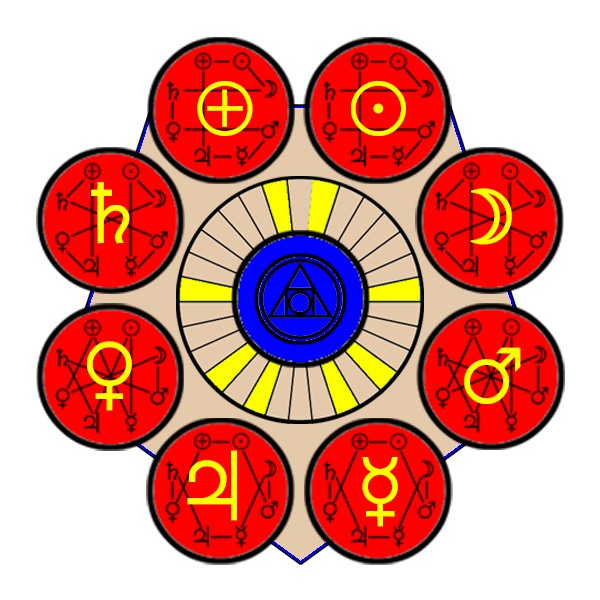
Left: Occult Styling of my 'Prime Clock' Right: Alchemist's 'Ancient Chaos' diagram.
I have intentionally color-matched my 'Prime Clock' and my rendering of the 'Ancient Chaos' diagrams. My original Prime Clock diagram would have been drawn by pencil on paper. The version I originally saw in Newton's notes (directly below) has hard to read annotations but is still fully recognizable. I provided several other historic versions in my article "Comprisation," which helped me redraw it accurately above.
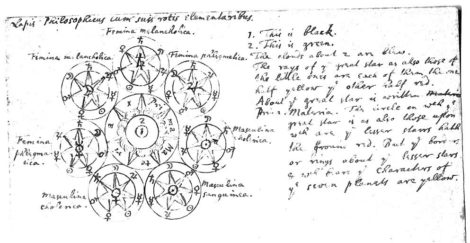
Newton's version of the 'Ancient Chaos' was copied into his personal notebook.
Let's briefly analyze the graphic elements in my Prime Clock diagram:
- Center Wheel — This is the 30-Slice Prime Wheel from "The Numbers."
- Center Rays — The Eight Rays correspond to each prime 'slice.'
- Outer Wheels — The Eight Outer Wheels are assigned as Regulators, one per slice.
- Outer Symbols — Planetary symbols I arbitrarily assigned to each prime. Originally used in Comprisation," to obscure the numeric solution to a simple puzzle I presented.
- Outer Patterns — The patterns are a third periodic layer regulating the on/off behavior of the eight primes originating in the wheel. They each have an internal symmetry, a partner symmetry, and a symmetry between all eight. You can review this in "Doomsday Mechanism."
Top Down Fails — Bottom Up Wins
I attempted to analyze the symbol arrangement in the "Ancient Chaos" and found it incomplete. The planetary symbols were not arbitrary for the Alchemists, though, they represent chemical elements — known metals in particular. My best assessment was that the Alchemists, following "As Above, So Below" thought that specific arrangements and interactions between metals would inevitably be provided by planetary...motion, alignment, guidance? This was the path to a "Crowning of Nature." They were searching for natural law extending beyond even Newton's contribution to Universal Gravitation. And these laws would be revealed in the Heavens.
These were not stupid men. They just took a wrong turn in the solution space and ended at a dead end. But their inspiration for the Periodic Table of Elements lives on today.
The symbols in the Prime Clock illustration above have no association with planets, or chemical elements. They are just substitutes for certain numerals that represent elemental Prime Numbers.
AI Psychosis and Prime Number Theories
My original interest in this topic developed after reading about a Black Hat Conference Sponsor who was blocked from presenting his "Infinite Prime Prediction" by the audience. I had been taught to know that the topic belonged with theories of Time Travel, Alien Abduction, and Perpetual Motion. But something about Robert Grant, a former medical executive, and Grant's choice of venue seemed out of place for an intentional grifter or a crazy person. You can review my assessment in "The Numbers PART TWO".
Robert Grant developed a 24-slice wheel incorporating prime numbers, colors, and musical notes. His paper does not reference Isaac Newton or alchemy, but Newton wrote about similar correspondence between 7 elemental colors (R,O,Y,G,B,I,V) and 7 music notes (A,B,C,D,E,F,G). 24 hours in a day and 7 days in a week might compel one to construct a 'divine symmetry' around either of these numbers. But as I illustrate in The Numbers, numerical primes organize themselves very differently.
Why So Quick to Judge?
Introducing a "new theory of prime numbers" quickly evokes hostility and derision. No other topic in math leads to such immediate dismissal. Perhaps an order to the prime numbers threatens deeper philosophical beliefs; beliefs surrounding both free will and a godless universe.
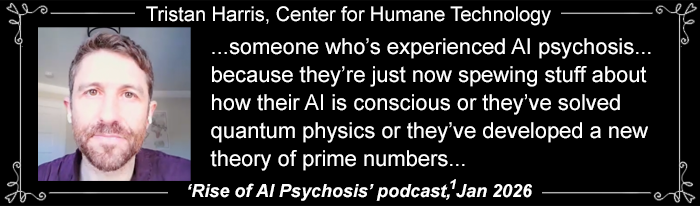
One aspect may be the "crabs in a bucket" effect. "Why do you think you can solve a problem that the greatest minds previously could not. Do you think you are so much smarter than the rest of us?" But advances in human knowledge continually require new theories. There will be pushback from stakeholders defending their own pet theories. But nothing to get one booed off a conference stage for merely suggesting an alternative. What is so sacred about the Primes?
Deterministic and yet Indeterminable
The Prime Numbers appear to offer the single most salient example of a predetermined order (numbers are fixed in place and never move around) that is also indeterminable by any technique previously known to man. You cannot tell in a sequence when the next prime number will occur. You just have to identify it when you get there. In some sense, prime numbers appear to exhibit some kind of free will. We can't tell when or where one will next appear. There may be something self-affirming in that.
Prime Numbers are the Elements of the Numeric 'Philosopher's Stone'
The Pythagoreans would not have referred to the Unifying Order of the Cosmos as a "Stone." I hope I have established that the "Stone" reference was part of a hint for an Alchemical recipe. In our current quantum physics era we might identify all these as searches for a "Grand Unifying Theory[2]." A model that explains everything. The Pythagoreans believed, in a very deep, religious sense that numbers and shapes were the primary elements of the Universe. This is very different from later cosmologies built up from Aristotelian Elements or Atoms and the Void.
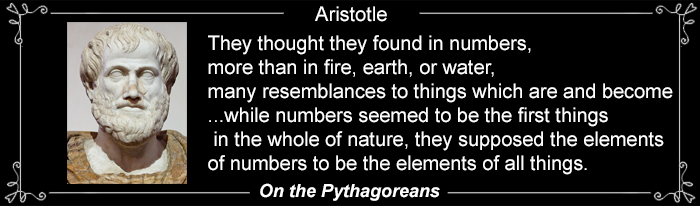
You can review more details in "The Elements".
The word ATOM comes from combining the prefix "a" with the root "tom," meaning not + cut. It should represent the smallest indivisible unit. But quickly after abandoning the Aristotelian four element model, science began finding ways to break the indivisible atom into component parts. First, the central nucleus orbited by one or more electrons, and then even the nucleus took on multiple protons and neutrons.
Searching for the true "rock bottom" of elementary matter, physicists continued to split the atom into even smaller components. They discovered these sub-subatomic particles by smashing things together in high energy colliders. In his 1961 paper, 'The Eightfold Way,' Murray Gell-Mann proposed that sub-subatomic particles were the components of protons and neutrons. These smallest units of matter he named 'quarks,' and it takes three to form a single proton or neutron.
Quarks have cleverly named sets of attributes, like "up" or "down." "Up" has a +2/3 charge and "down" has a -1/3 charge. A proton is made of "up-up-down" quarks with {+2/3,+2/3,-1/3} = +1 charge. A neutron is made of "down-up-down" quarks with {-1/3,+2/3,-1/3} = 0 charge. So quark charges add up correctly! Other strange attributes were detected in these experiments, and Gell-Mann named a new property "Strangeness." Adding 'strangeness' to the 'up' and 'down' attribute choices, Gell-Mann created a diagram for this newest elemental model, which should remind the diligent reader of the Pythagorean Tetractys.
Gell-Mann coined new terms in physics via literary reference — 'quark' was from the novel Finnegan's Wake, and 'Eightfold Path' references Buddhist teachings. It's possible the Tetractys was a similar historic nod. But what is notable is that the Pythagorean diagram applied to high energy physics predicts a final 'strange-strange-strange' particle (Ω−) that was not discovered until years later.
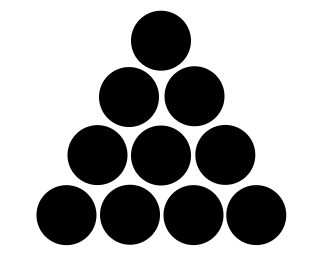
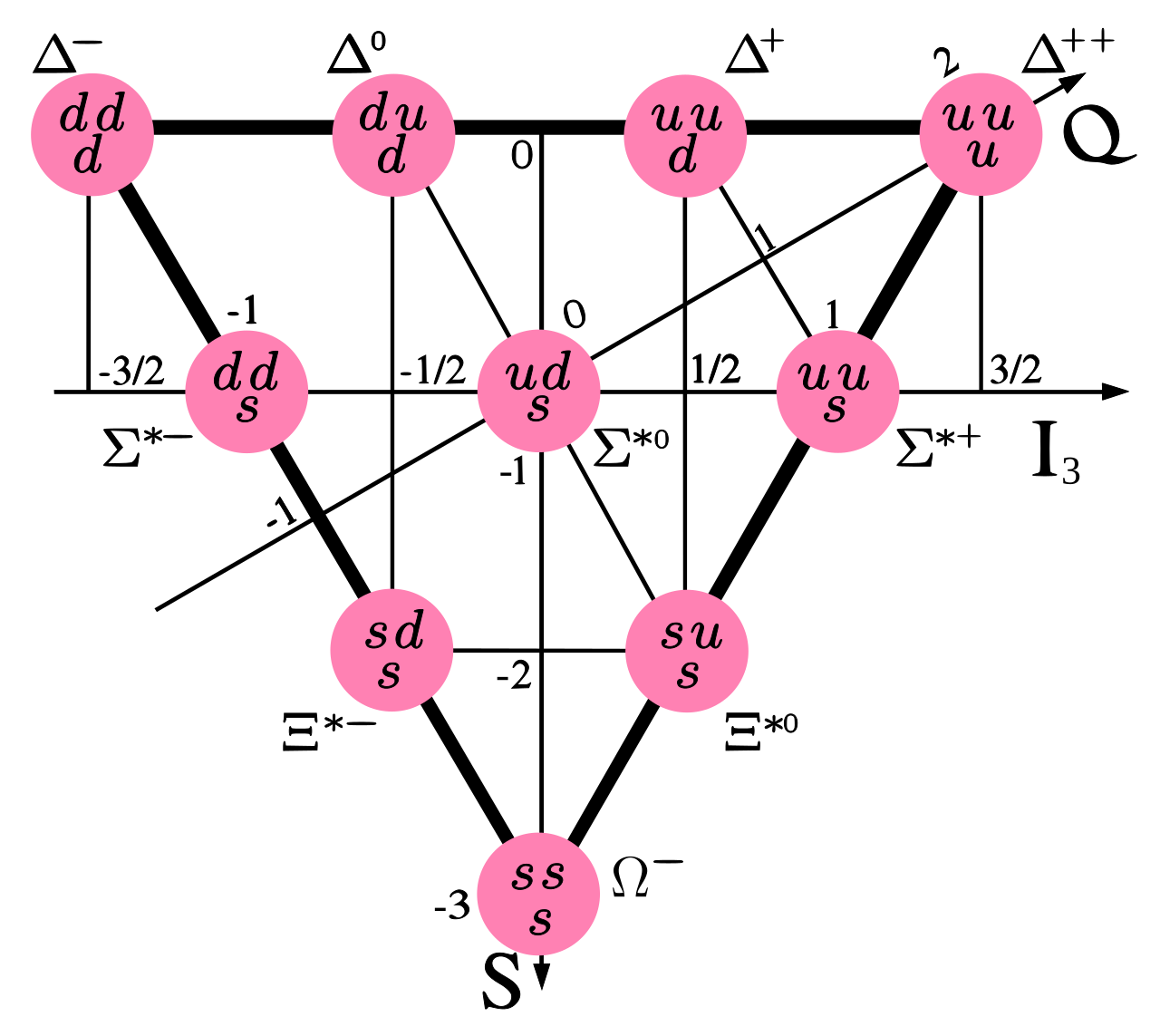
Left: Pythagorean's Divine 'Tetractys' Right: Murray Gell-Mann's "Baryon Decuplet" predicts Ω−.
A Fourth 'Philosopher's Stone'?
I hope you have picked up on the pattern here. A Unifying Model of the Cosmos begins with defined Elements, that then take on some type of symmetrical arrangement. The theory is that everything else in existence comes from the recombination of this smallest set of unique Elements. The models must reflect periodicity and display self-reference. These are the Philosopher Stones.
Physics is still working on its "Grand Unified Model." Gravity is an unincorporated component with some physicists still searching for a physical "graviton." But even without fully capturing the Quantum Realm, the Periodic Table (the Third Stone) captures the physical world at a chemical level. Chemical Engineering works fine even without defined quarks, 'strangeness,' or gravitons.
The Primary Stone
The Pythagoreans defined "number" as the minimal element defining reality. But are all numbers equally elemental? No.
Prime Numbers have been defined in a backward, subtractive manner: A prime is any number that is divisible only by one and itself. That definition puts Prime Numbers last, conceptually. You need to know all the other numbers that might divide into it first. We learned a trick in "The Numbers" that we 'only' have to check all the numbers up to the square root of a candidate prime. Only. So lots of trial division, and essentially the "Sieve of Eratosthenes" approach.
A better definition would call the Prime Numbers what they really are: The Elements from which all other numbers are composed. If we think of Prime Numbers as atomic elements, all other numbers are molecules. Like molecules, all composite numbers are made up of two or more prime numbers, bound together through multiplication. CO2 is one carbon atom bound to two oxygen atoms, just as 12 is 3*2*2.
Prime Numbers create all other numbers in the numeric realm. The challenge with identifying them as elements of a Philosopher's Stone — an original pattern of the Cosmos — is their apparent lack of PERIODICITY.
If we continued to discover new chemical elements that were not accounted for in the Periodic Table, we would need a different table. If Prime Numbers stream off into infinity with no rhyme or reason, then we have elements for a Philosopher's Stone, but not the periodicity and self reference required.
Assembling the Prime Clock...
1. "Your Undivided Attention" Podcast. Episode with Dr. Zac Stein,
"Attachment Hacking and the Rise of AI Psychosis" 44:10
2. "Grand Unified Theory" or GUT is the term for the current attempt under the particle physics model. I am extending the term slightly to refer to other models which attempt to include theories of everything, including self referential, and 'Will of God" type models.