Philosopher Stones PART TWO
Not All that Glitters

March, 2026
Previously on Philosopher Stones...
In Part One, we covered the age-old search for Divine Symmetry and asserted that "Prime Numbers are Elements of the Numeric Philosopher Stone."
Enter the Prime Clock
To get started, let's suppose your favorite trusted AI announced the following.[1] A group of graduate students in the department of Advanced Mathematics and High Energy Physics discovered a formula that accurately identifies all prime numbers. Their work has already claimed the Fields Prize in Mathematics and has been submitted for a Nobel Prize. From their groundbreaking paper, the formula for Prime Numbers:

This formula has all the magic symbols we have come to expect but only understand tangentially at best: Summation from zero to infinity, the imaginary number 'i', exponents, factorials, and calculus. We even have several undefined constants using Greek letters. Seems legit!
Under these circumstances, you would not be outraged that a citizen scientist could find an alternate method utilizing geometry. You would simply want a compelling demonstration. So let's keep that mindset: fully skeptical yet not dismissive in our analysis of the Prime Clock. (BTW, I create footnotes for a reason).
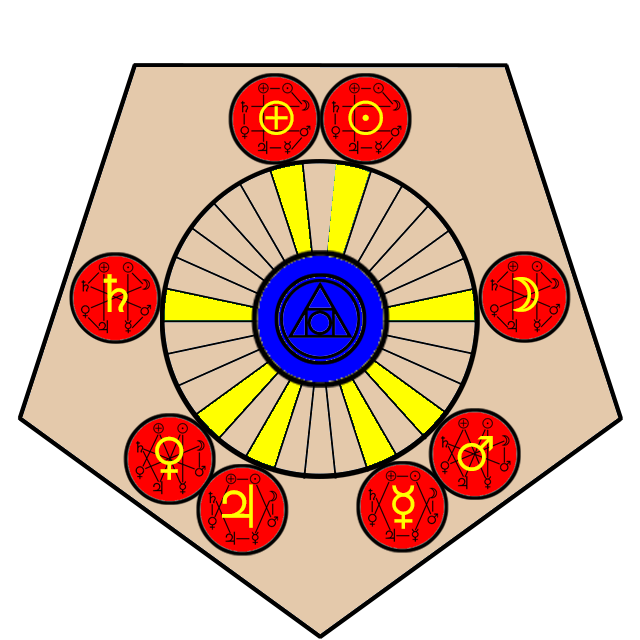
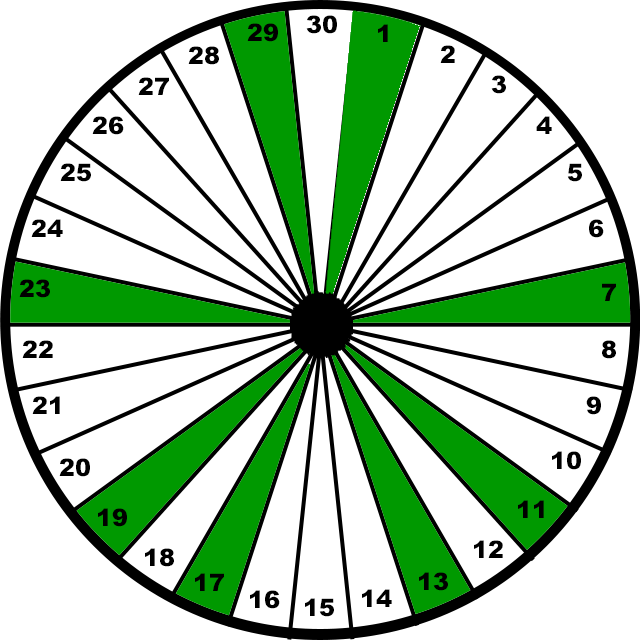
Left: Prime Clock with smaller-diameter regulators. Right: Original 30-Slice Prime Wheel.
A lot was going on with the exploration of Prime Wheels as covered in The Numbers. Let's focus on how the 30-Slice Prime Wheel can be both Periodic and yet cover the infinite expanse of Prime Numbers.
The hands of an analog clock rotate clockwise around a series of 12 numbers. As it proceeds through time it always outputs One through Twelve O'Clock. If a Prime Wheel worked exactly the same it would output 1-30 over and over, or if focused on Prime Slices it would output the series 1-7-11-13-17-19-23-29 repeatedly. That's periodic, but not headed to infinity.
The important difference between an analog clock and a 30-Slice Prime Wheel is that each ROTATION is incremental. So the first rotation outputs only the slice values, but the second rotation outputs 30 plus each Slice. Third rotation outputs 60 plus the Slice. And so on. Here is an illustration from "The Numbers".
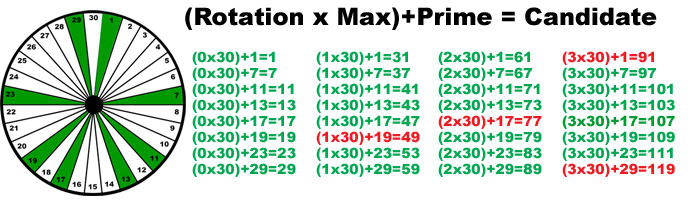
There are two important things to notice in these four columns of numbers. First, EVERY SINGLE PRIME IS PRODUCED, NO EXCEPTIONS. These are the Green Rows. The second thing to notice is the Red Rows. These are non-prime composite numbers that slip through the cracks. In the second column, 30 plus the Prime 19 intersect and produce 49, which is 7*7, so not prime. The third column also has a Red composite and the fourth column contains two composites.
Without fail, the Prime Wheel is producing all of the Prime Numbers. But unseen interaction between the primes allows Composites to slip through, and the percentage of Composites grows with each rotation. If you create a larger Prime Wheel, you can reduce the number of Composites created. To build a larger Prime Wheel, you need to know what all the Prime Slices will be. And a tantalizing prospect is to start with a small wheel and use it to generate the Prime Numbers needed for the next larger wheel!
Unfortunately, while larger wheels create fewer non-prime Candidates, they will always create some. The final lesson from The Numbers is that the quantity of Composites grows faster than you can add additional slices to a "The Numbers PART FOUR" bigger Prime Wheel.
Very few people will start the quest to find the pattern in Prime Numbers. We were advised it's not possible. For the vanishingly rare adventurer, the ultimate failure of Prime Wheels brings a sense of assurance. The reason it hasn't been done before is because it can't be done, and now we know why.
Unless...
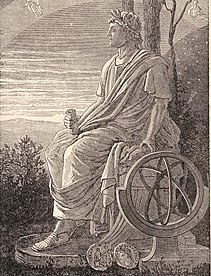
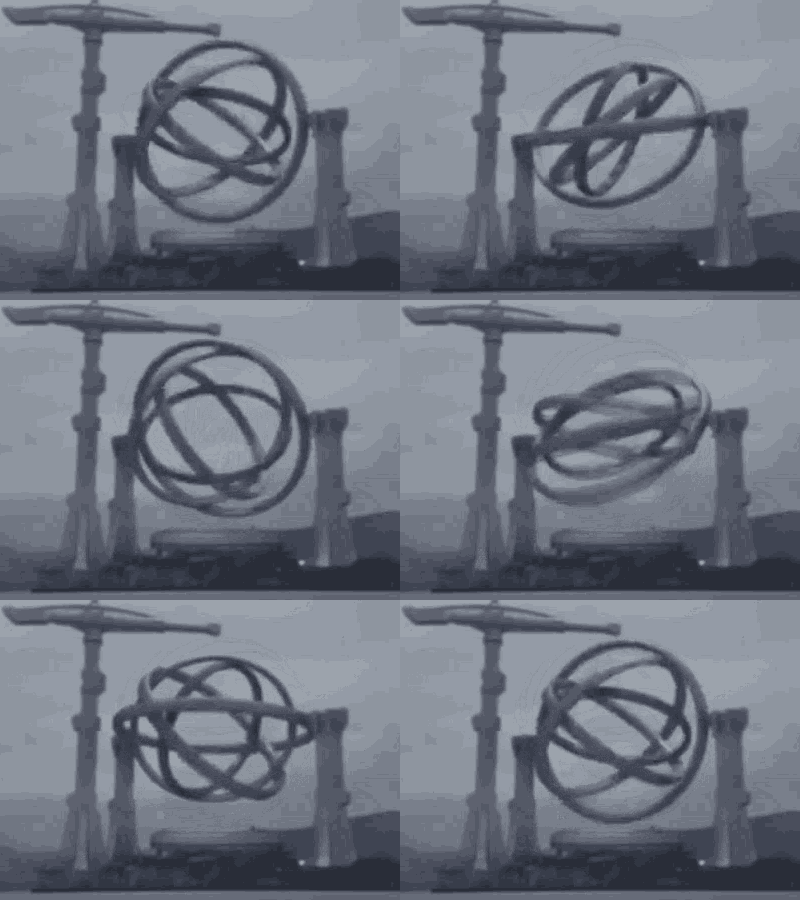
Eratosthenes' Armillary Design encrypted within a prime number stream from space[2]
Watching the intersecting rings of the armillary sphere might suggest some type of sophisticated pattern. What unexpected number series could it possibly produce?
After much consideration you might realize that the Prime Wheel itself already produces ALL the Prime Numbers to infinity. And it does so in a periodic fashion. The missing enhancement is a mechanism to BLOCK the production of Composites.
Looking at the Red and Green rows for the 30-Slice Wheel (above), you can notice the Composites that leaked through: 49, 77, 91, 119. Start there. OK, all of those numbers are divisible by the prime 7. So can we block composites created by 7? Yes. The 'Thirty" of the 30-Slice Wheel comes from 2*3*5=30. This Wheel blocks Composites of 2, 3, and 5. If we wanted to block composites of 7 we would need a 210-Slice Wheel (2*3*5*7=210). That works, but we already went down that path in The Numbers and concluded the Wheel size just keeps growing. We need a "Prime Clock" or some symbolic technique to eliminate composites. Back to square one.
If we can't just block 7s what about the other Primes involved in the Composite? 7*7=49, 7*11=77, 7*13=91, 7*17=119. So 11, 13, and 17 are all primes on the wheel. Can we block them instead? If we go past the output for the 4 rotations I am showing above, it keeps happening. For example, at the 20th rotation the Composite 623 is produced. 623=7*89. Eighty Nine is not anywhere on this Prime Wheel! So that doesn't work, and there were many more composites on every rotation and they don't all involve 7. In fact, ALL the Primes along the way, being the Elements they are, will tend to bind with one another and create ever more Composites.
"Contact" or "Mission Impossible?"
At this point, I'm with you. Everything I've brought up only seems to confirm this is an impossible quest. I discovered the Prime Clock solution about two years ago, and it scared me, so I hid most of the digital evidence and put it behind me. I wanted to know much more about what the discovery meant before unleashing something dangerous on the world. Many of the articles on this site document that exploration.
One of the most important techniques in Cave Diving is to establish a guide line on your way in, so you can hold onto it and find your way back out. In a deep penetration dive, you will establish stage areas with extra tanks along the guide line. Over several months working on the Prime Clock, I made notes, lists, spreadsheets, diagrams, and eventually an application. I know the destination is real, but I have to grab onto the guide line and lead us back there.
Into the Weeds
I previously wrote that the definition of Prime Numbers was backward, leading us to believe they were some sort of outlier. I will repeat part of a quote from The Numbers PART THREE:
"The prime numbers belong to the most arbitrary and ornery objects studied by mathematicians: they grow like weeds among the natural numbers, seeming to obey no other law than that of chance, and nobody can predict where the next one will sprout."
—Don Zagier, 1975
If we just look at the series of Prime Numbers starting at 7, do we intuit a pattern?
7, 11, 13, 17, 19, 23, 29, 31, 37, 41, 43, 47, 53, 59, 61, 67, 71, 73, 79, 83, 89, 97, 101, 103, 107, 109, 113, 127, 131, 137, 139, 149, 151, 157, 163, 167, 173, 179, 181, 191, 193, 197, 199 ...
No. You might be teased by small patterns but they fall apart even across this short series. Don Zagier's quote seems to capture the experience.
Slicing the Wheel
You may have noticed I left off numbers under 7 in that list. Let's pay that a quick visit. The 30-Slice Prime Wheel has a Slice for 1 and not for 2, 3, or 5. The omission of 2*3*5 is because their product is 30. If we make a 210-Slice Wheel we omit 2*3*5*7. If you output a list of primes produced by a prime wheel, you prefix these few primes at the beginning of the list.
The '1' slice is a very interesting case. All of the Prime Wheels start with 1. Modern convention in mathematicsis that 1 is not prime for various reasons. However, many past mathematicians included 1 at the beginning of the primes list. The Pythagoreans did not consider 1 to be a prime number because they didn't consider 1 to be a number at all! It was a 'unit,' and 2 was the first 'number.' This aligns with the ability of numbers to be multiplied and result in new numbers. '1' can't do that. You just get the same number back. Ultimately, I think this follows my assertion that the Primes are Elements from which all other numbers originate.
The conventions for the numbers and slices on a prime wheel are determined by what works. If you tried to follow a theory and omit the 1-Slice, you would end up not producing all of the prime numbers from the wheel. Also note the bi-lateral symmetry of the wheel. 1 is paired with 29, and adding them equals 30, the max size of the wheel. The remaining slices each have a mate, and in each case they always add to 30. No exceptions. However, symmetry is the result of a system that works. Merely imagining alternate symmetries will not produce a working system. This is the mistake of many mystical endeavors.
Reversing the Mindset
The challenge seemed to be finding the pattern generating prime number "weeds." But this is backward, since the Prime Wheel already produces all of the primes. They don't need to be found. The weeds sprouting out of the Prime Wheel candidates are actually the Composites. The true challenge is to identify the pattern generating COMPOSITES!
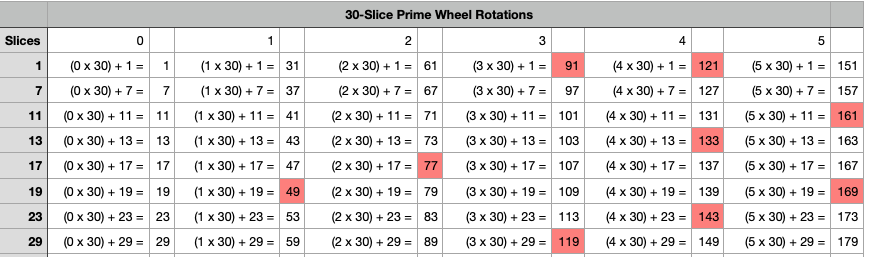
The table (above) shows the results of the first 6 rotations. Red cells are Composites that are produced. You can see that a higher percentage of composites is produced as the rotation number increases.
hPrimes — The Hidden Primes
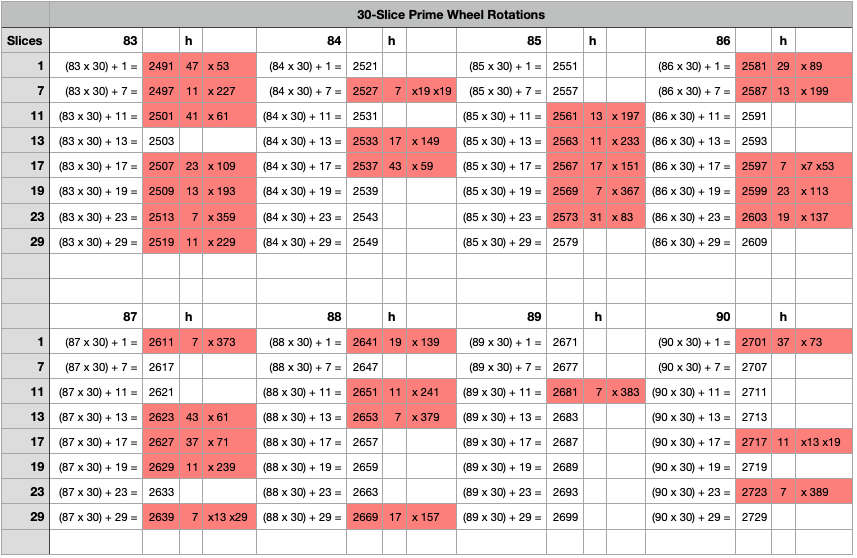
This table shows rotations 83 through 90. By rotation 83, ALL of the candidates are composite, except from slice 13 (i.e., it produces the prime 2503). And on rotation 89, NONE are composite except slice 11. So finding the pattern for Composites directly won't be easy either.
I've added columns titled h and populated the value for the lowest prime number that is 'hidden' in the composite. If we focus on the top-left corner of the table, we can see that on Rotation 83, the number output by Slice 1 is 2491. 2491 is a composite number, the product of 47 and 53. This is a first step. What we are really looking to do is predict that on Rotation 83, Slice 1 will produce some kind of composite number, so we will SKIP it. There will be no more computationally expensive trial division to detect it after the fact. If we can accurately predict ALL of the Rotation:Slice intersections and skip them, the Prime Wheel will produce ALL and ONLY Prime Numbers.
I populated the spreadsheet above by hand so you could see what candidate number (prime or composite) the Prime Clock would generate, and I used trial division to determine which cells to color Red.
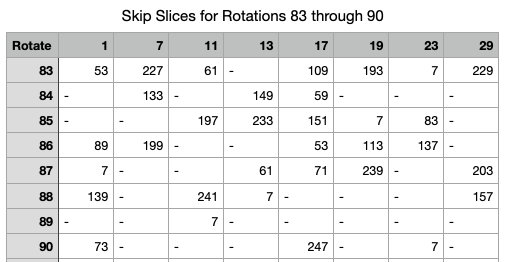
'Skip Matrix' excerpt as produced by the Prime Clock application
The data above is from an array that the Prime Clock application creates. It's called the "Skip Matrix." I'm just showing rows 83-90 to match the rotations of the spreadsheet example. The column headers across the top are the Slice values. The Prime Clock application calculates this table for all the rotations needed just prior to spinning through the 30-Slice Prime Wheel, and any cell for that rotation with a number in it is skipped. The number is for diagnostics, but it could just be an 'X'. It's that simple. For cells containing a dash, the Prime Clock will perform the normal calculation, resulting in the next unique Prime Number.
But How is the Skip Matrix Populated?
'How' is the million dollar question, and right now, this second, I don't know the answer. I did know at the time I discovered the solution, but we are starting back near the surface, and I'm pulling us down along the guide rope. Re-reading my own articles is providing the clues necessary for going deeper:
The next step was to chase down what was happening across all the "Fail Reason" composites. What was the minimal prime factor for the "Fail", on which slice, and under which rotation? Write it all down.
After gathering data from a substantial number of rotations, it's time to rearrange components of the data into rows and columns of a spreadsheet. There will be a stack of papers with multiple pencil notations, circling each diagram. It's determination, like Jodie Foster on the hood of her car, scanning raw data for some sign of intelligence. I was "on the hood" for about a month.
And then...there it is.
--Darren Lott, "Doomsday Mechanism PART TWO."
Welcome to the FAIL Matrix
Below is a table I labeled the 'FAIL Matrix,' produced as part of the initial analysis of a 30-Slice Prime Wheel. It captures when the wheel produced a Composite instead of a Prime Number. Let's use the bottom-left corner as an example. The 19 at the bottom left represents the output of Slice 1 on Rotation 12. The output would be (12 * 30) + 1) = 361. Visually, this candidate (361) looks like it might be prime. To test it, we need to see if it divides evenly into any other prime starting at 7. (7 nope, 11 nope, 13 nope, 17 nope, 19 YES. 361/19=19.) This is the Trial Division process, and it takes gets longer and longer as the candidate numbers get larger. If the number is actually prime, the test takes the longest. You need to keep trying the next prime divisor all the way up to the square root of the candidate, and only when none of them divide evenly is the candidate confirmed prime! This has to be done for every cell in the table (not just the ones with numbers in them).
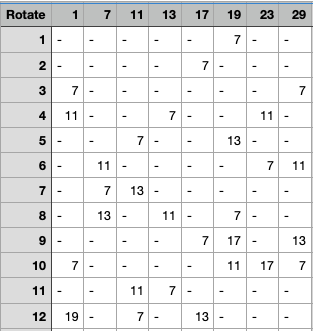
'FAIL Matrix' produced by Trial Division after the fact
On the Hood
Here, an unrelenting belief in a pattern was required. The 30-Slice Wheel automatically eliminates any Composites divisible by 2, 3, or 5. So if I match a wheel based on a Prime that shows up in composites and note the Slice, maybe there is a pattern there. Let's use the top-left corner wheel with the big 7 label (below) as the example. I would like to skip any candidates divisible by 7, so 7 is the 'Skip Number.' We will call the wheel the 7-Skip-Wheel. The green number sections are the 'Slices,' and the Red numbers on the outside of every Slice are 'Red Numbers.' Looking at the FAIL Matrix above, the key is to assign each Slice a Red Number, representing the Rotation that target prime was first noted on. Row 1 of the Fail Matrix shows a 7 in the column for Slice 19. So Slice 19 on the 7-Skip-Wheel gets a Red 1 outside Slice 19. Just looking at the 7s in the table lets you match up the Red Numbers and their slices on the 7-Skip-Wheel.
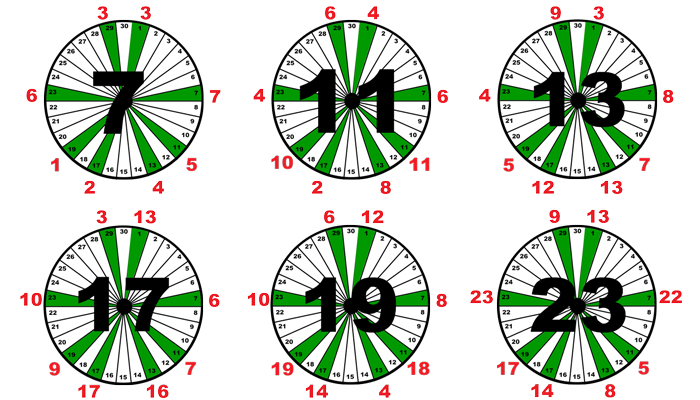
Looking at all the Red numbers for all the Skip-Wheel diagrams, we are not yet noticing much of a pattern emerging. To populate the 23-Skip-Wheel, I needed to see the FAIL Matrix extending further than the Rotations 1-12 shown above. It needed to extend down to Rotation 23 since there is a Red Number 23 at slice 23.[3] So there is some sort of pattern. But nothing definitive yet. Each Skip-Wheel has a Red Number of the Skip Number on that same numbered Slice. So Red 23 at Slice 23 on the 23-Skip-Wheel. Red 19 at Slice 19 on the 19-Skip-Wheel, and so on.
There are also Red Number repeats from one Skip-Wheel to the next one. Notice the Red 2 on Slice 17 for both 7-Skip-Wheel and 11-Skip-Wheel right after it. This doesn't show in the FAIL Matrix for both 7 and 11, rather for 7 only. But (2 * 30) + 17 = 77 = (7 * 11). So Slice 17 on Rotation 2 produces a Composite using both Skip Numbers (7 and 11). It was not obvious from the single values in the FAIL Matrix, but I later discovered that the Red Number for a Slice must be the FIRST time the Skip Number is used in a Rotation. This required some hand calculation to verify the Red Numbers as the Skip-Number-Wheel values got larger. And they did.
I printed out templates like the graphic for the 6 wheels above. They included skip-wheel diagrams up to the 103-Skip-Wheel. And I populated and confirmed all the Red Numbers for every Slice. Along the way, I pondered that populating each additional Skip-Wheel was like adding another Prime to an ever-larger Prime Wheel. But without having to add all the other slices to the Wheel. Remember from "The Numbers" that a wheel which skipped primes through 41 would require over 300 Trillion Slices.[4]
Clearly, this hinted at a method far more effective than building bigger static wheels. This method seemed to be indicating a DYNAMICALLY growing Prime Wheel was possible.
To accomplish this I need some theory that PREDICTS which Slices at which specific Rotation will produce a Composite. Can I find a repeating pattern using the verified Red Numbers I've already recoded?
What Pattern Could Possibly Repeat?
1. This is a fictitious account, but believable enough. The formulas and theories in modern physics are far more incredulous than prime number periodicity. This is actually the formula for the Dyson Expansion Series from Quantum Electrodynamics (QED)
2. The 'Hokkaido Machine' from the book and movie 'Contact.' Much more about this is covered in '"Pareidolia".
3. The actual FAIL Matrix I was working with extended to 333 Rotations. (333 * 30) + 29 = 10,019. So all the Prime Numbers and Composites up to 10,019. This was sufficient to reveal that pattern I had been seeking.
4. To Skip primes through 41 would require a wheel sized 2*3*5*7*11*13*19*23*29*31*37*41. Discussion at '"The Numbers PART FOUR".