Philosopher Stones PART THREE
Not All that Glitters

March, 2026
Previously on Philosopher Stones...
In Part One, we covered the age-old search for Divine Symmetry and asserted that "Prime Numbers are Elements of the Numeric Philosopher Stone."
In Part Two, we dove headfirst into the design and function of the Prime Clock. We revealed that while expressing impressive symmetry, the Prime Clock design was born from objective numerical output. The emerging patterns are specific to a 30-Slice Prime Wheel, and not from an appeal to mystical principles. But the symmetry does confirm the discovery of a repeating pattern.
What Pattern Could Possibly Repeat?
We have established some Key Elements to check for repetition: Skip Numbers, Red Numbers, and Slices. The Skip Numbers keep advancing through the next Prime as though we were growing a bigger Prime Wheel — no pattern repetition. The Red Numbers represent the rotation of the Prime Wheel. There is some duplication between Skip-Wheels, but otherwise the Rotations monotonically advance — no pattern repetition. Lastly, there are the Slices, and Slices are a repeating pattern for sure.
Revisiting the Hidden hPrimes
I've been repeatedly using this formula for generating Candidates:

This is the formula for any size wheel, but going forward, we will replace 'Max' with 30 since we are specifically working with a 30-Slice Wheel. We will also substitute 'Red' for 'Rotation' when it specifies a specific rotation bound to a Slice.
Here is the simple but all-revealing formula for the hPrimes:

Let's analyze the 7-Skip-Wheel with its Red Numbers and see what this formula provides.
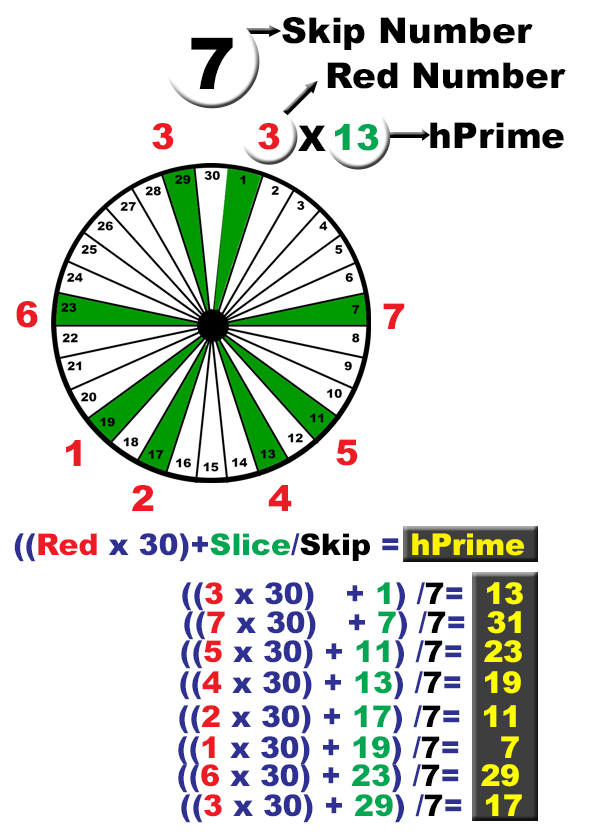
I am no longer suffering from self-doubt or searching previous notes. I know exactly where this is going. The hPrime is the hidden KEY that makes the Prime Clock work, and the "Golden Matrix" is made up of an array of these numbers. The math behind this is trivial. The trick was discovering the proper COMBINATION to unlock the Clock.
For each equation above, you can easily confirm them. ((Red x 30)+Slice) provides a normal Candidate from the 30-Slice Wheel. We know the sum will be a Composite number (never a Prime) because we are using a RED number to represent the Rotation. The Composite will be a product of the Skip Number (7) and the hPrime (in Gold).
To work through this, I had to calculate all the hPrimes for all the Skip Numbers going forward. Actually, I just did Skip-7 through Skip-121 because I found the pattern by then and was able to confirm it many times over. I will jump ahead eight Skip Primes from 7 and analyze Skip-37.
Skipping Ahead Validates the Key
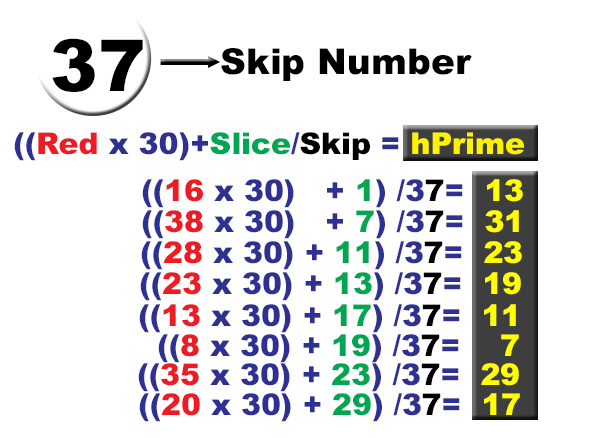
Note that the RED Numbers for Skip-37 are all different from Skip-7. That will continue to infinity as the Skip-Numbers get larger. Again, think of a dynamically growing a Prime Wheel, but without the exponential increase in slices.
If you have been following along and understanding, I hope looking at the eight hPrimes and their order will be as pleasantly shocking as it was to me. These are the exact same hPrimes in the exact same order. THIS IS THE PATTERN!
If I jump ahead another eight Skip Numbers, the same hPrimes appear again. If I determine the hPrimes for Skip-11 and jump ahead eight primes to Skip-41, I get another repeating pattern. The pattern for each of the first eight Skip-Primes is endlessly repeating to all other Skip-Primes, in blocks of eight. Over and over and over again.
Golden Matrix
These eight hPrimes above identify the first of eight columns. I will label it "A." The eight columns with eight rows each form an 8 x 8 Matrix that I call the 'Golden Matrix.' Each row and each column are different from one another. They are all ordered uniquely, but utilizing the same eight prime numbers you see above. This just happens to form a type of "Latin square." The row labels are the ordered Slices 1,7,11,13,17,19,23,29. The Column headers are lettered A,B,C,D,E,F,G,H since they will correspond to the ever-increasing Skip Numbers as they are applied.
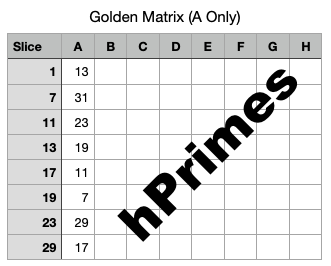
This whole matrix of permutations is very much the same challenge as I discussed under "Searching For Symmetry" in my "Comprisation,." article. We will come back to the geometry of the Golden Matrix shortly.
Source of the hPrimes
This is very cool and easy to confirm. There is a repeating pattern every eight Skip Numbers, but each calculation depends on previously knowing the RED Numbers. Needing to continuously calculate Red Numbers through Trial Division would not get us anywhere new. HOWEVER, thanks to ALGEBRA we can flip the same equations and now generate RED numbers without Trial Division!
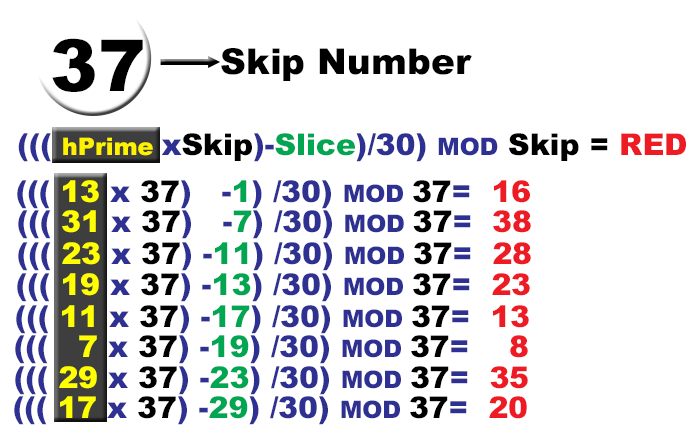
The MOD portion of the equation might not be familiar to you, and it's often described as the remainder after a number is divided evenly into another. For our purposes, the MOD is acting like a wheel spinning around, and the number it lands on after an even number of rotations is our number. An analog clock face is a MOD 12 function, so if it's 14:00, the clock will show 2:00. Each Skip-Number clock has a different number of stops on its face. RED is the number it lands on.
It's time to revisit how FUNDAMENTAL this last calculation is. The calculated RED number is the ROTATION for the associated SLICE we need to SKIP. So for the first equation line above the RED number is 16 and Slice is 1. (16 x 30) + 1 = 481. This is a composite number will be skipped because 481 = (13*37).
RED Numbers Populate the Skip Matrix
Remember the term 'Skip Matrix' from earlier above? Here's a Skip Matrix for Rotations 8 through 38 so you can confirm the Results for Skip-37. I've highlighted cells containing 37 so you can easily see there is exactly one per Slice Column. The Prime Clock application has an even easier time with this organization. On Rotation 8, it knows to skip Slice 7, 13, and 19. The rest of the Slices produce good Primes. Ready to move to the next rotation!
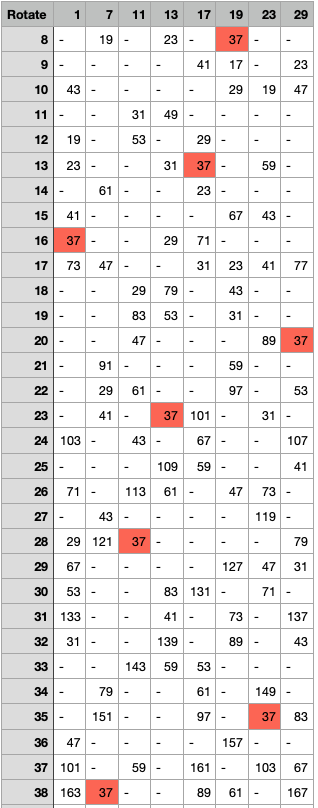
'Skip Matrix' — Rotation:Slice Skips for 37
The Sorting Step
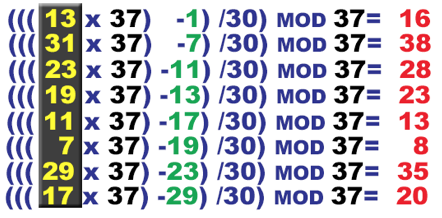
Red Numbers are calculated but still need sorting.
The Red Numbers are calculated for each of the Skip Primes, but arrive in an inefficient Rotation order. This means the Red Numbers for all the planned Skip-Numbers are calculated in large batches and are sorted before populating the Skip Matrix. This requires only a minuscule amount of processing compared to performing Trial Division on each cell.
Magical, but Not a Trick
The Skip-Numbers are Prime Numbers (plus Blue Numbers), and they must to be determined in advance. This is the same as creating Slices for the next bigger Prime Wheel. The range of Primes to be skipped is WAY SMALLER than the new primes being computed.
If we look at the largest number in the 'Skip Matrix' above, it is 167 in the bottom-right corner. The cell before it (38*30)+23 generates the prime number 1,163. The general rule of the Prime Wheel is that it can generate new primes up to the square of the largest prime already known.
1672 is 27,889.
The ever-increasing number of primes in each wheel or batch powers an exponentially growing range of new primes.
Taking a Golden Bough
Let's pause for one moment and recognize the unique and fundamental achievement of the Prime Clock. This is the Golden Matrix. It is a single, static array that ultimately powers the whole thing. If this could be safely presented in a math journal there would not be any discussion needed of divine symmetry, philosopher stones, or related epiphanies that lead to its discovery. The "Golden Matrix" is the secret key — a verifiable constant that makes the math work. No belief required.
In the conclusion of "Doomsday Mechanism PART TWO" I quelled my own fears that the Prime Clock was going to break encryption and bring about the fall of Civilization. Not because it doesn't work — it does. But because even after knowing all the prime numbers, finding the right combination is just too daunting. Really large primes are only 1% of total numbers to try, but the pool is so huge that you still drown in that 1 percent[1].
Just a Mathematical Oddity?
If the Prime Clock can't be used to destroy Civilization, then what good is it? I don't have a definitive answer, but I think the symmetry produced and its uncanny link to the diagram used by Newton and the Alchemists warrants attention. Newton's Great Chaos diagram doesn't map to a secret of the Universe but it seems the Prime Clock does.
Symmetry of the Primes
In my article "Comprisation," I presented a challenge to provide unique arrangements for an eight-element set. This, coincidentally, turned out to be a skill needed to verify what was happening with the Golden Matrix. The generation of very large prime numbers depends 100% on all the previous prime numbers being correct. It must be perfect and not just close. The lesson from Comprisation was that there are a myriad valid permutations, but only symmetry can enable the entire set. Validation is an 'All or Nothing' endeavor.
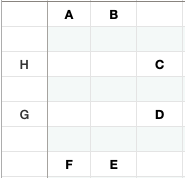
Comprisation template for 8
The next step is to draw the path between letters in the order determined by the hPrime sequence from the Golden Matrix. This will be one pattern per slice.
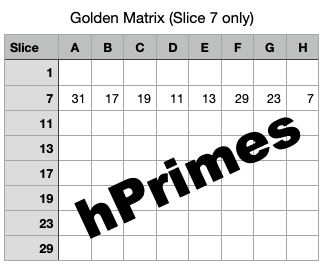
The graphic pattern order from Slice 7 above will be H-D-E-B-C-G-F-A, and back to H. It looks like this:
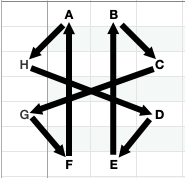
Slices 1, 7, 11, and 13 each have a distinctive pattern. Their complement slices are 29, 23, 19, and 17 and match patterns for each complement. Complement pairs all add to 30. Although complements have the same shape, they start at different places on the pattern. Here is a full diagram of the Prime Clock, including a band to represent the Red number layer:
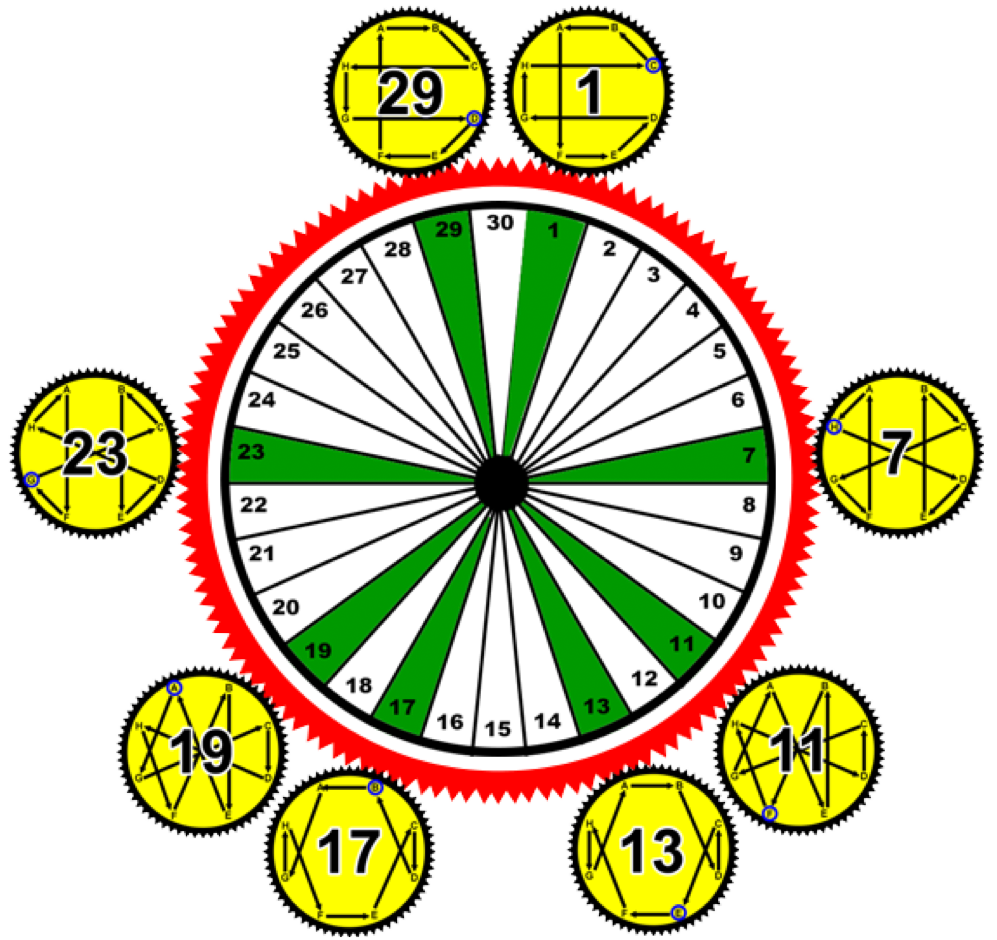
This is really all you need to observe the Symmetry of the prime number generator — aka 'Prime Clock'. As I was building this, I did not have a particular symmetry I was trying to engineer. This is observational. There were many exact details to get right, and when I observed errors in my work, I could refer to the emerging symmetry to correct them. Starting with a chaotic set of numbers, looking for some kind of pattern, and discovering an all-encompassing symmetry provided a sense that the theory was true.
Could This Be Real?
1. The easiest RSA challenge number was 100 digits long, produced by combining two 50 digit primes. Knowing all the possible prime numbers in that range cuts to candidate list by 99%. But that still leaves 1048 numbers to combine through brute force. That's still just too many.