Philosopher Stones PART FOUR
Not All that Glitters

March, 2026
Previously on Philosopher Stones...
In Part One, we covered the age-old search for Divine Symmetry and asserted that "Prime Numbers are Elements of the Numeric Philosopher Stone."
In Part Two, we dove headfirst into the design and function of the Prime Clock. We revealed that while expressing impressive symmetry, the Prime Clock design was born from objective numerical output. The emerging patterns are specific to a 30-Slice Prime Wheel, and not from an appeal to mystical principles.
In Part Three, we advanced to specifics on the Golden Matrix and how it drives the Skip Matrix. Ultimately, knowing the exact Rotation and Slice is how the Prime Clock blocks production of Composite Numbers, while still leaving all the Primes.
I Want (You) To Believe
Some readers are not going to accept that the Prime Clock works, despite having been stepped through explanations in Parts One, Two, and Three. Let's visit some critical takes on ways the Prime Clock may not be what it seems:
Critic's Take #1: This is an Intentional Hoax
Finding another Philosopher's Stone may appear even more grandiose than claiming to find the pattern in Prime Numbers. Frankly, the entire topic of the Philosopher's Stone never interested me until I stumbled onto Newton's 'Great Chaos' illustration. Their similarity in organization (the circular rotation of elements around a prime generator) compelled me to investigate how the two could be related:
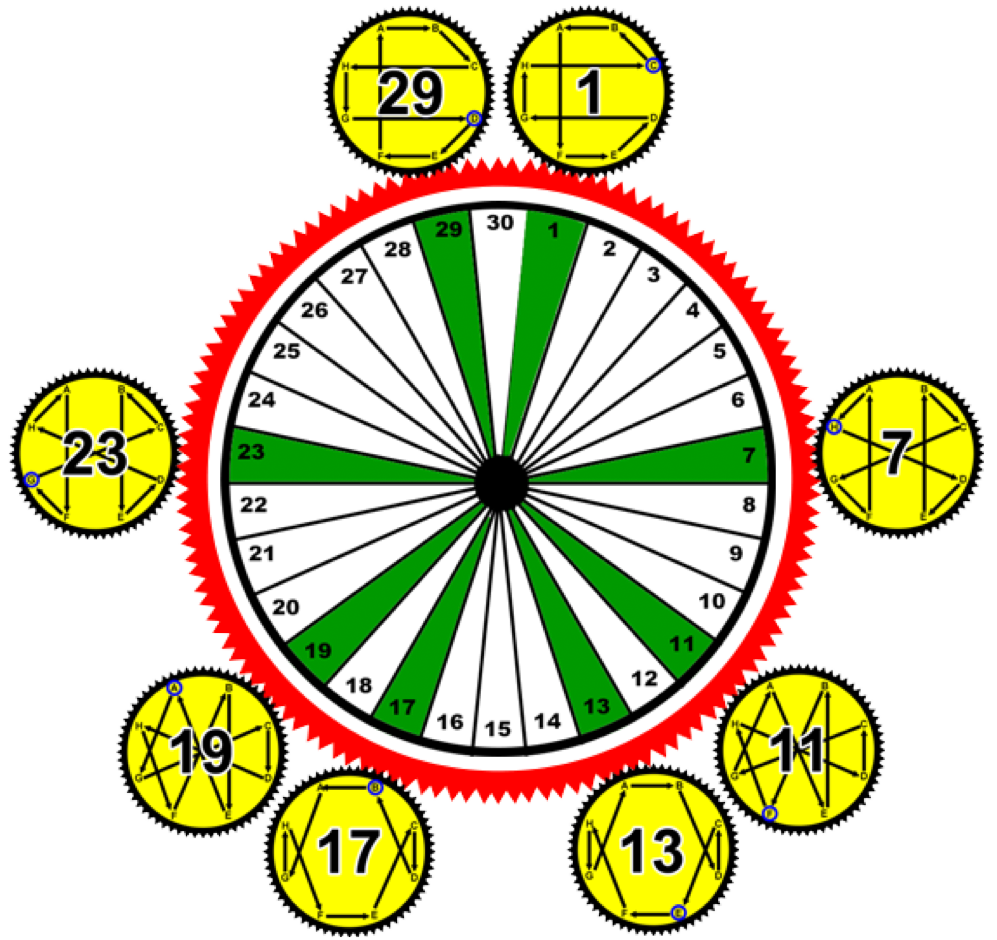
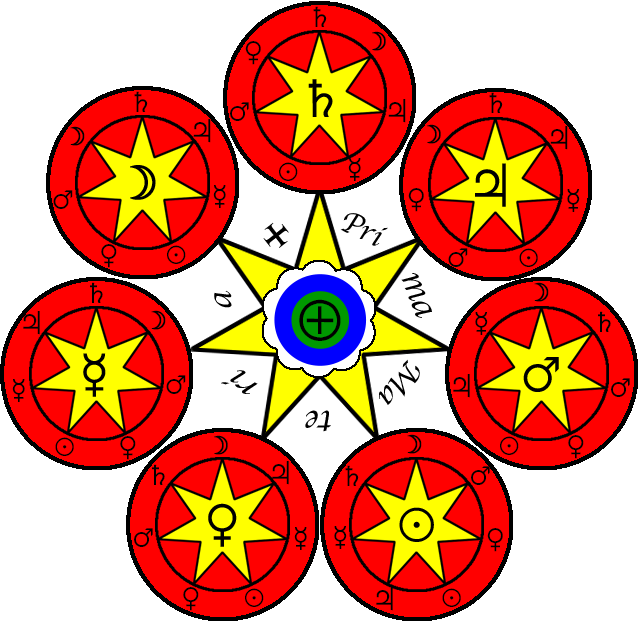
If I had just proposed that the Prime Clock Illustration was an "Epiphany of a Divine Symmetry," it would be reasonable to dismiss the entire claim. So I have been very deliberate about showing the work behind the illustration via simple math that can be replicated. It's not just a claim. It's a theory that can be methodically confirmed or disproven.
In the end, my association between Prime Numbers and another Philosopher's Stone is separable. There is no prize for finding "The Lost Philosopher's Stone" and it's not the type of theory that can be proven or refuted. But you may find their symmetries a useful way to organize your thoughts. The attempt to find 'Elements of the Cosmos' and the 'Rules that Govern' has its own pattern repeating through history. The Prime Clock could be ideationally bombastic, but it's not a hoax.
Critic's Take #2: This Must be a Mathematical Fallacy
Provided that you followed the simple math from parts One, Two, and Three you could question whether this appears miraculous but is actually a special example of an "Invalid Proof." These types of proofs are algebraic manipulations that purport to show impossible things, like 2=1.
x2 = xy
x2 - y2 = xy - y2
(x+y)(x−y) = y(x−y)
x+y = y
2y = y
2 = 1
What's hidden above is an implicit divide-by-zero operation. Or more simply, an assignment of y = 0.
These types of fallacies fall apart when real numbers are assigned to the variables in the algebraic argument. This is another reason I supplied verifiable values for all the examples I provided previously. The simple work I've provided is mathematically valid.
Critic's Take #3: Self-Working Number Magic?
"Self-Working" magic tricks are the easiest to learn since the scenario of the trick guarantees a successful outcome. There is no sleight of hand or other skillful illusions required on the part of the magician. Self-working card tricks are the most popular, but there are examples with numbers also:
Choose any number between 1 and 20. Don't tell it to me.
Now add 1 to your number, then double it.
Add 4 to this new number and then divide it by 2.
Lastly, subtract your original number from the total and think HARD about the result.
The number you're now thinking of is THREE!
This works because mathematically the result is always 3, no matter the initial choice. If you represent the scenario in a formula, it looks like this:
(((x+1) * 2) + 4)/2 - x
The first 'x' in the formula is the participant's chosen number, and the minus x makes it go away. That leaves 1 times 2, which is 2, plus 4 is 6, divided by 2 is 3. Always. Self-working magic invariantly produces a fully expected result.
There are many examples of forcing various numbers with various levels of obfuscation. I picked this example because the formula reminds me of the hPrime formula:

Of course, the Prime Clock formulas are very different in that they generate NEW values from different inputs, not the same invariant number like a Magic Number formula. It may seem magical, but it is not based on illusion.
Critic's Take #4: It's Not Extensible
In designing the first application to produce Primes from a simple 30-Slice Prime Wheel, I had the advantage of validating its output against a public list of known primes up to 1 million. This was an important step. After proving the Prime Wheel produced valid primes beyond 1 million, I used Prime Wheel output to validate much larger numbers (up to a billion) against the Prime Clock.

Above a billion, the Prime Wheel becomes too slow to experiment with, but the Prime Clock is still going strong — a few minutes versus hours. Primes above a billion fall to the Prime Clock exclusively.
Here is a text file starting at 1 quadrillion and listing primes for the next 100,000 (i.e. up to 1,000,000,000,099,981).
List of Primes above One Quadrillion
You can pick any number in the list and check it yourself against any on-line Miller-Rabin prime validator. Miller-Rabin is a probabilistic generator and not the deterministic generator of the Prime Clock. But it should give you confidence that the Prime Clock is fully extensible within your limitations for time and compute.
Critic's Take #5: This is Still Somehow Trial Division
The inverse of division is multiplication. A division approach means every step forward requires a trip back to the beginning. A multiplication method can charge forward without looking back. This is certainly how the Prime Clock behaves.
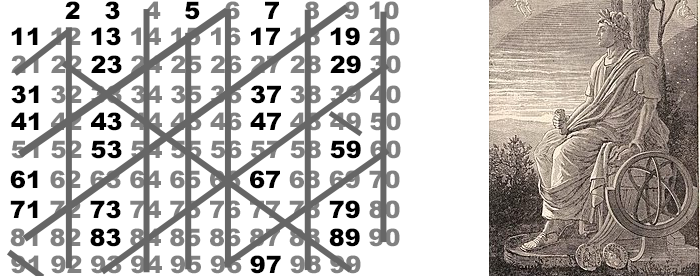
The Sieve of Eratosthenes eliminates composites on a Grid. Could an Armillary provide a similar outcome?
Critic's Take #6: The Solution Should Be a Simple Equation
The history of science seems to favor men who captured phenomena with the shortest set of symbols: Pythagoras — a2+b2=c2; Newton — F=ma; Ohm's Law — V=IR; Einstein — E=mc2, etc..
These formulas are simple because the relationships they represent are simple. Fermat tried to capture prime numbers with his simple equation: an-1 MOD n = 1, but it's not reliable[1].
The Fibonacci Sequence is similar to the Prime Numbers. Promisingly, a simple and reliable formula to validate a Fibonacci Number was found:
The Fibonacci Sequence is the closest challenge to the Primes in that every subsequent Fibonacci number depends on previous Fibonacci numbers: 1,1,2,3,5,8,13,21,34...
Fibonacci has two properties we WISH we could discover for the Primes:
Every new number generated from the previous two will be correct. There are no "Candidates" that require separate validation. And given a larger, isolated number, a formula was discovered to test its "Fibonacci-ness": If n represents a Fibonacci number, then either (5n2+4) or (5n2-4) must yield a perfect square
— "The Numbers PART FIVE."
Fibonacci validation yields a simple formula because the actual dynamic of adding the prior two sums is also very simple. Prime Number generation requires many more dimensions of complexity.
If I were to guess some type of symbolic representation that might model the Prime Clock, I would intuit some type of complex Fourier series involving (three?) major waves, each composed of (eight?) smaller waves. Something like that. But it would be missing something important.
Every type of equation is symbolic, whether simple or complicated. Philosophically, there is a camp that believes all of Reality can be represented symbolically. A more tenable position is that Reality can be represented Mathematically, which critically includes Geometric representations. Importantly, the Prime Clock is not a symbolic representation.
The Prime Clock represents primes Geometrically. It may be the simplest geometric representation of primes possible. You could probably base a physical device on its design to chug along the counting numbers and spit out Primes as they occur. Another type of non-symbolic representation for complex behavior is "Cellular Automata." We will explore those after this last "Critic's Take."
Critic's Take #7: It Must Loop Back On Itself at Some Point
This concern plagued me while writing this article. It has been about two years since I found the pattern, successfully applied it, and made the visual diagram. Reacquainting myself by working backward from the diagram, I keep thinking, "How can eight rotating wheels surrounding a center rotating wheel not loop?"
The 30-Slice Prime Wheel has eight slice values, and each of the Outer Regulators has only eight golden values. This might feel like there would be 8 x 8 permutations before repeating, or maybe even 88 permutations.[2] That's a lot of possible permutations, but if the inner and outer wheels were the only components, the Clock would start repeating itself. However, there is a critical element visible in the illustration above, the Red Number ring.
The Red Numbers can also be thought of as a unique pairing between a wheel Rotation and a Slice. The Slice portion is limited to 8 values, but the Rotations increase incrementally over time. It seems trivial, but it's the Rotation number that never repeats and drives unique Prime Numbers forward.
(The theory's) first applications are necessary to elementary problems where the result has never been in doubt and no theory is actually required. At this early stage the application serves to corroborate the theory. The next stage develops when the theory is applied to somewhat more complicated situations in which it may already lead to a certain extent beyond the obvious and familiar. Here theory and application corroborate each other mutually. Beyond this lies the field of real success: genuine prediction by theory.
-- von Neumann and Morgenstern, "Theory of Games and Economic Behavior," 1944John von Neumann was widely considered smarter than all the other great minds of his time, even smarter than Einstein. His professors were afraid of the speed and power of his mind. Claude Shannon called him "the smartest person I've ever met."
The meaning behind von Neumann's quote was that if you want to create a viable theory, you need to start with verified observations. Facts about which there is no doubt. These would be Prime Numbers that anyone can confirm easily by hand or in their head. Your theory needs to match these simple results one-to-one, and then extend to results "beyond the obvious and familiar." For the Prime Wheel application, which matched the output against a validated list of primes to one million. "Here theory and application corroborate each other mutually."
The reach of von Neumann's "field of real success: genuine prediction by theory" meant looking at the problem from the opposite side: Find the pattern within all the FAILURES. The Red numbers are observed failures, and there is no repetition or simple rule for producing them. There is no rule for producing the Gold hPrimes either, other than they are mathematically produced by the non-repeating stream of Red Numbers. Detected only through indirect observation, the Gold hPrimes yielded a static Golden Matrix. Its repeated application generates all the Red Numbers. And the Red Numbers allow a perfect stream of Primes to infinity.
Spiral into the Void
1. Fermat's formula says 561 is prime, but 561 is a composite (3x11x17). There are a whole class of Composites that Fermat's theorem fail to detect named "Charmichael Numbers." There was more about this in "The Numbers PART FIVE."
2. 88 = 16,777,216 which is a lot of values. However, millions is still far short of billions, trillions, or QUADRILLIONS. If the Prime Clock became invalid after some large number of rotations then a valid list of prime numbers in the Quadrillions would not be possible, and you have a LINK to confirm for yourself.