Philosopher Stones PART FIVE
Not All that Glitters

June, 2026
Previously on Philosopher Stones...
In Part One, we covered the age-old search for Divine Symmetry and asserted that "Prime Numbers are Elements of the Numeric Philosopher Stone."
In Part Two, we dove headfirst into the design and function of the Prime Clock. We revealed that while expressing impressive symmetry, the Prime Clock design was born from objective numerical output. The emerging patterns are specific to a 30-Slice Prime Wheel and not the result of an appeal to mystical principles.
In Part Three, we advanced to specifics on the Golden Matrix and how it drives the Skip Matrix. Ultimately, knowing the exact Rotation and Slice determines how the Prime Clock blocks production of Composite Numbers, while still leaving all the Primes.
In Part Four, the critics take a shot at explaining away the magnificence of the Prime Clock. Each concern is addressed.
The Nuclear Option
John von Neumann's best friend was fellow mathematician Stanislaw Ulam. John helped to recruit Stan to work on the Manhattan Project where Ulam eventually made a significant contribution to the hydrogen bomb design[1]. Both men were interested in Cellular Automata (CAs), which I will introduce in the next section.
Soon after publishing his 1960 paper on CAs, Ulam found himself bored at a scientific conference and began to doodle a solution for prime number generation. What came from this were two concepts that became associated with his name — "Ulam Lucky Numbers" and "Ulam's Spiral." It also inspired the 1964 March cover of Scientific American.
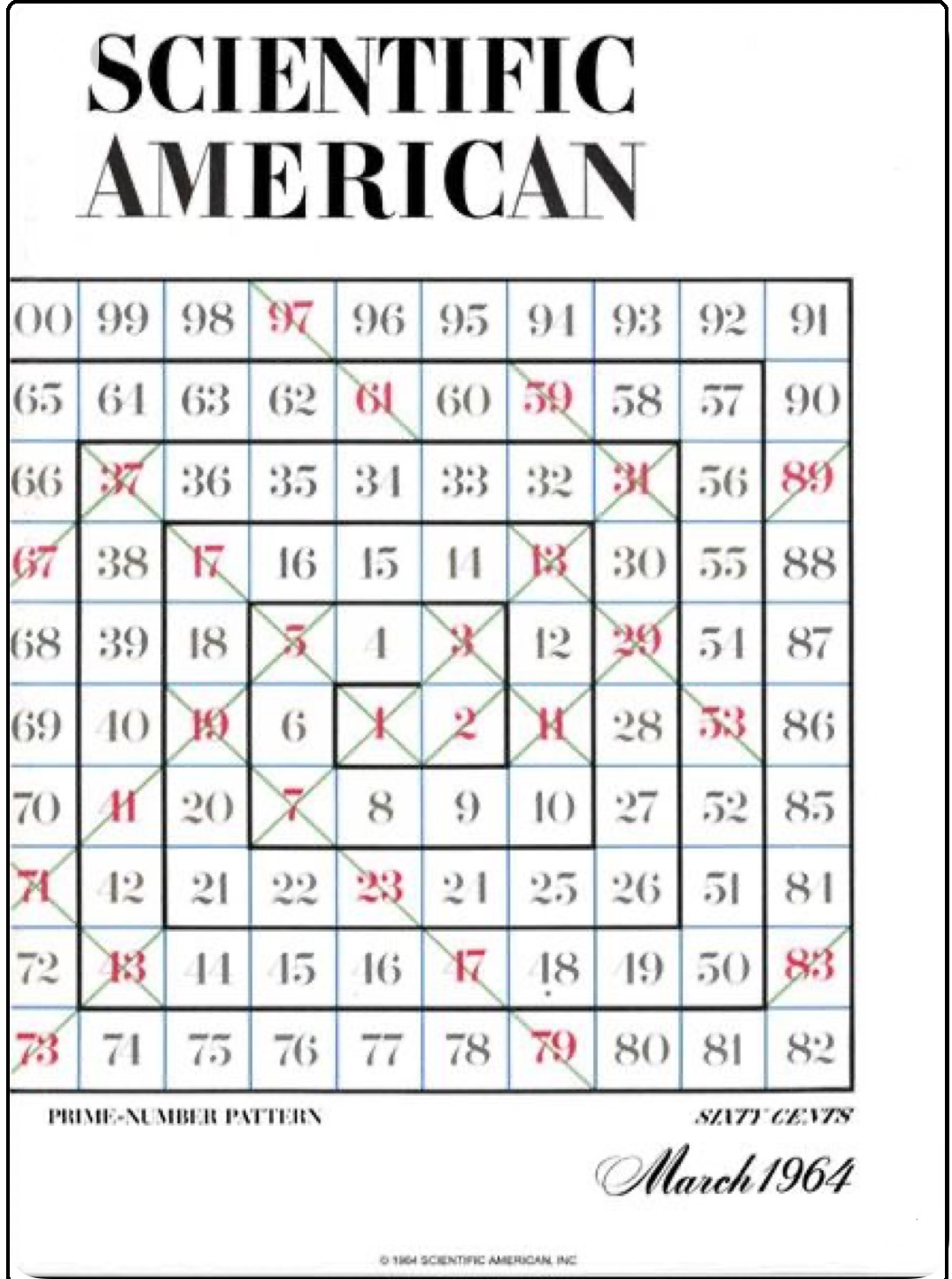
Starting with '1' at the center, the magazine cover uses diagonal strike-throughs to note the prime numbers. This may remind you of the reverse method for strike-throughs used in the Sieve of Eratosthenes illustrations. Ulam notably referred to this method of sequence generation also as "sieves."
f(n) = n2 + n + 41
Euler Primes (18th Century)
As a boy, Ulam studied the work of Leonhard Euler, a famous Swiss polymath from the 18th Century. Euler was fascinated by prime numbers and could recite the first hundred from memory. His formula above is notable for the constant '41,' which is part of Ulam's 'Lucky Numbers.' It is called 'lucky' for an historical reason.
In 67 AD, Jewish general Josephus was fighting against the Roman army when he and his 40 men became trapped in a cave. Rather than surrender, Josephus suggested they draw lots to form a mutual death circle, cut the throat of the next man, and pass the sword to the next 'lucky' survivor. In the end, Josephus himself was 'lucky' and left alive to tell the tale. Calculating the lucky number of the last survivor, with varying group sizes and skip rules, is now a popular math puzzle called the "Josephus Problem."
Ulam's handwritten spiral started with lucky 41 and continued outward for about 200 steps. It would have looked like this:
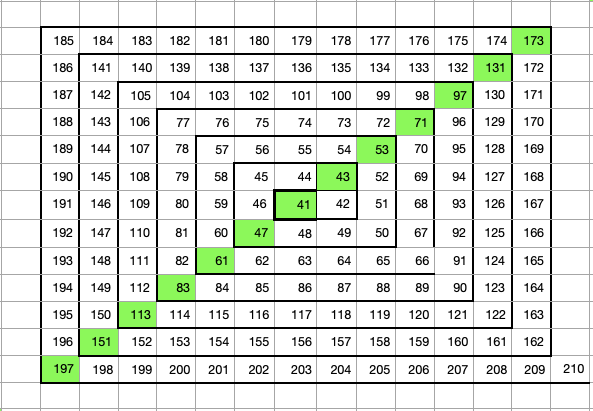
I have highlighted the diagonal passing through the starting point of 41, and you should notice that every green number on the diagonal is a prime number! You can also apply Euler's formula (f(n) = n2 + n + 41) and get an exact match!
Ulam's Spiral produced 100% Primes and was a 100% match to Euler's formula. Ulam was elated and brought his Spiral concept to the lab at Los Alamos to see what the new "MANIAC II" computer would reveal. I've created an extended run of Ulam's Spiral below:
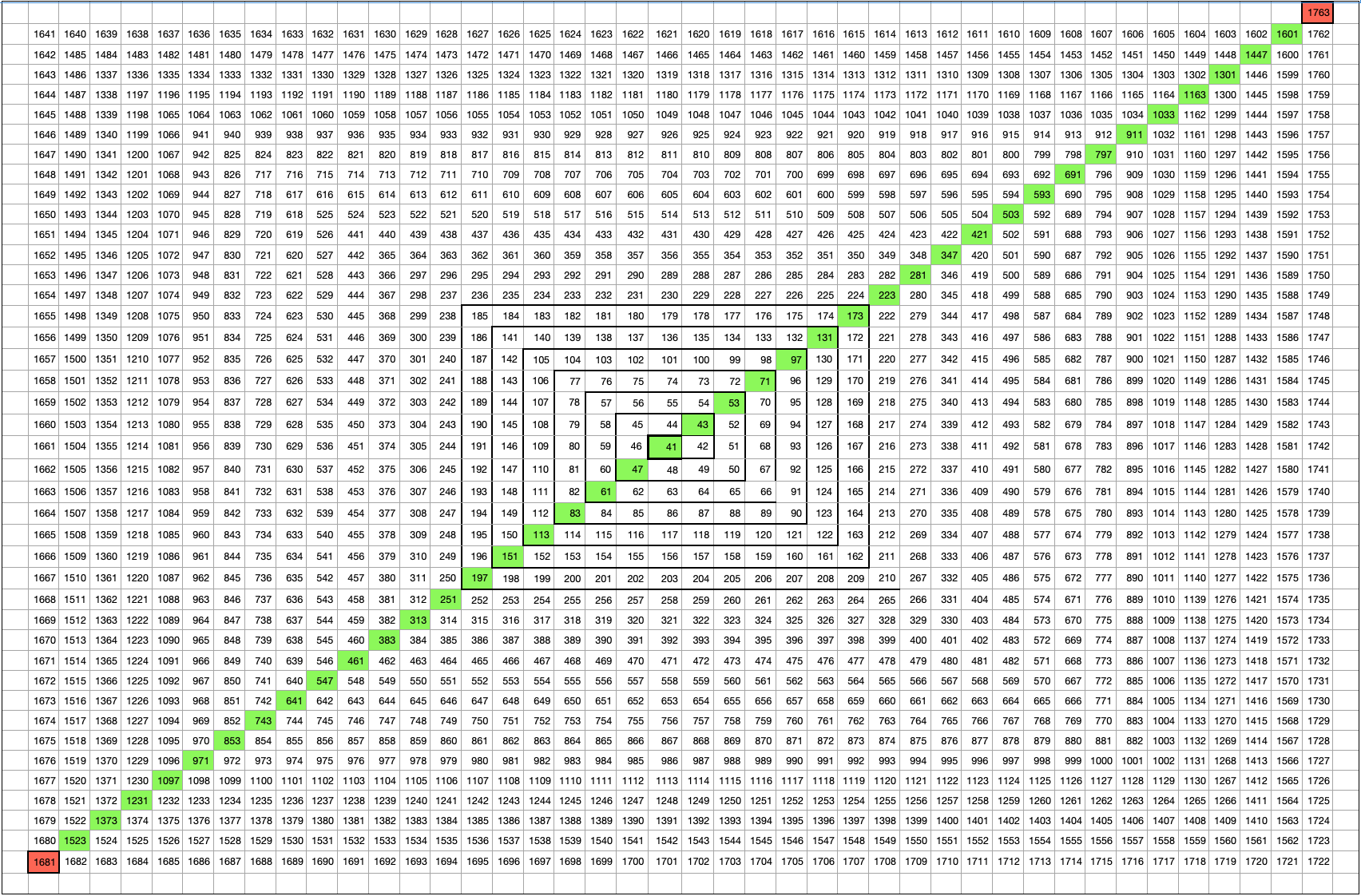
The numbers are pretty small on the web page, but you can zoom in and notice a few things: You can see that the method holds true and successfully extends further. All of the green cells are produced by Euler's formula and are prime. But that ends with the red cells at 1681 and 1763. These are also Euler numbers, but are not prime. The Spiral and the formula had a good run, but they ultimately failed following this visually compelling performance[2].
Ulam's Spiral might provide a compelling object lesson. Prime number generation can provide exciting initial success, only to fail when extended. We see this with Euler and with Fermat. Other attempts by great mathematicians as well. But an indicator I have noticed with the failed attempts is that they produce primes, but NOT ALL the primes, and this becomes obvious early on. Looking at Ulam's Spiral from that perspective, the Prime Clock generation differs fundamentally:
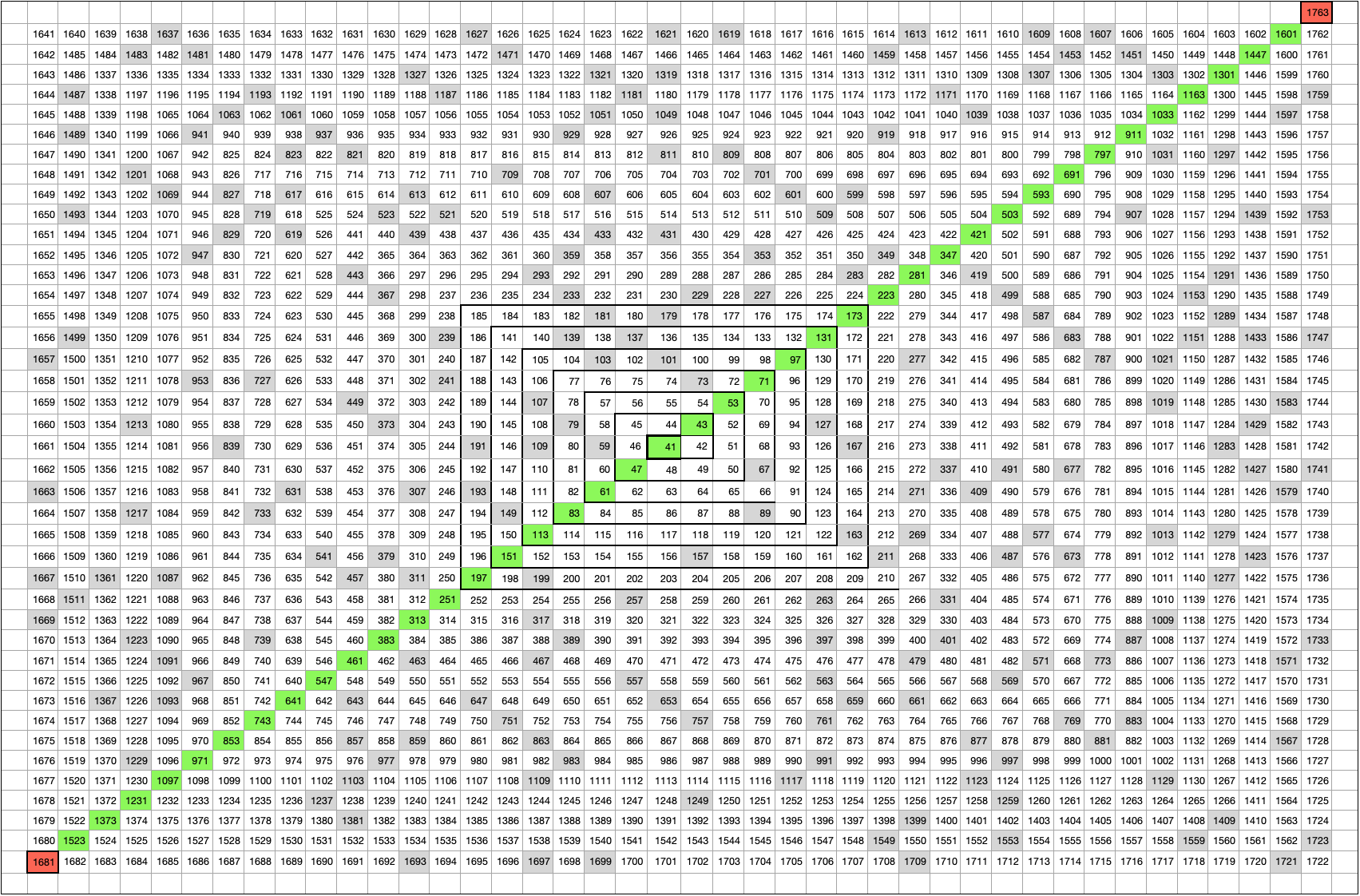
I have highlighted all of the cells with unidentified prime numbers. They represent a substantial percentage (over 600% more unidentified primes than those on the diagonal). These unidentified primes are also present in the set from Ulam's original 200 spiral. Although it's visually interesting, this method is not very good at generating prime numbers.
On the other hand, the Prime Clock produces every Prime Number.
1. Stanislaw Ulam, like John von Neumann was part of a group of polymaths in the 1940s that made foundational contributions to the fields of mathematics, physics, and computer science. In 1951 Ulam and Edward Teller came up with the "Teller-Ulam" design at Los Alamos, which became the basis for all megaton-yield thermonuclear weapons.
2. Ulam's spiral and Euler's formula will produce other diagonal runs of prime numbers, but this is the longest uninterrupted run at 40 generated primes.