Philosopher Stones PART SIX
Not All that Glitters

June, 2026
Previously on Philosopher Stones...
In Part One, we covered the age-old search for Divine Symmetry and asserted that "Prime Numbers are Elements of the Numeric Philosopher Stone."
In Part Two, we dove headfirst into the design and function of the Prime Clock. We revealed that while expressing impressive symmetry, the Prime Clock design was born from objective numerical output. The emerging patterns are specific to a 30-Slice Prime Wheel, and not from an appeal to mystical principles.
In Part Three, we advanced to specifics on the Golden Matrix and how it drives the Skip Matrix. Ultimately, knowing the exact Rotation and Slice is how the Prime Clock blocks production of Composite Numbers, while still leaving all the Primes.
In Part Four, the critics take a shot at explaining away the magnificence of the Prime Clock. Each concern is addressed.
In Part Five, we visit Euler's prime formula and Ulam's matching Spiral. Even facing the power of the Los Alamos Laboratory computer, the Prime Clock crushes their results[1].
Cellular Automata: A Similar Paradigm
It can be difficult to accept that a deterministic system can produce the type of behavior we associate with Prime Numbers. Don Zagier provided us with a characterization of primes sprouting "like weeds amongst the natural numbers," but then a sentence later, declaring "prime numbers exhibit stunning regularity." I think this captures the enigmatic nature of these numbers.
Von Neumann and fellow mathematician Stanislaw Ulam both published papers on "Cellular Automata" (CA) in the 1960s and are considered inventors of the field. The contribution of CA is to show how extremely simple objects (abstract "cells") following extremely simple proximity rules can exhibit complex behavior. The early CA models were really just squares on a sheet of graph paper. By 1970, mathematician John Conway created the eponymous "Conway's Game of Life," taking advantage of growing academic access to computers. These simulations produced self-replicating structures named "space ships," "gliders," "guns," and "puffer trains."
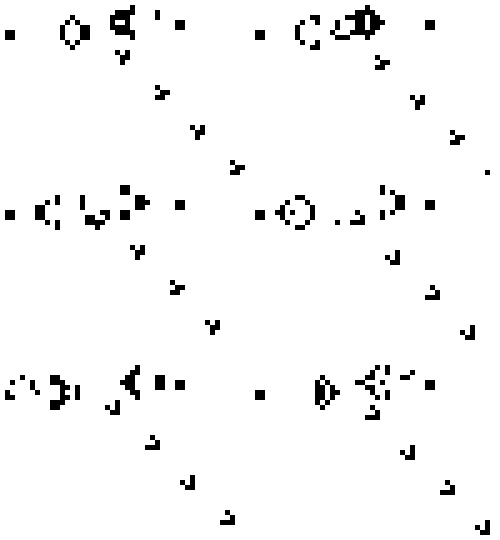
Each black dot above is a "cell," and the entire grid is analyzed at each time step to determine which cells "live," or "die," or are "born." The rules are based on the proximity of cell "neighbors." It is amazing to witness complex behavior from a simple 2-D simulation. But the simulation can be made even simpler.
Elemental Cellular Automata (ECA)
In Stephen Wolfram's 2002 book A New Kind of Science, Wolfram advocates the study of simple abstract rules. He argues that simple programs are enough to capture the essence of many complex systems. The simplest of these programs is the ECA, or Elemental Cellular Automata. ECAs are simpler than "The Game of Life," consisting of a single row of cells with only three possible on/off inputs per cell. There are only 256 unique configurations, and Wolfram named them "RULE 0" through "RULE 255". He characterized their individual behavior into 4 Classes. We will briefly go over an example of each:
Class 1 — Rule 32

Program for Rule 32. Bottom row of 8 squares is binary 32 — (00100000)
Above is what every ECA program looks like. The top row is always a triplets of cells, and the bottom row shows how to process that arrangement of left, center, and right above.
Class 1 ECAs result in Uniformity — either all white or all black cells. This occurs from any starting point in the first row. I started the animation with 3 black cells just so it doesn't end instantly. You can see from the rule that only a cell with Left and Right (not Center) above it will propagate the next row.
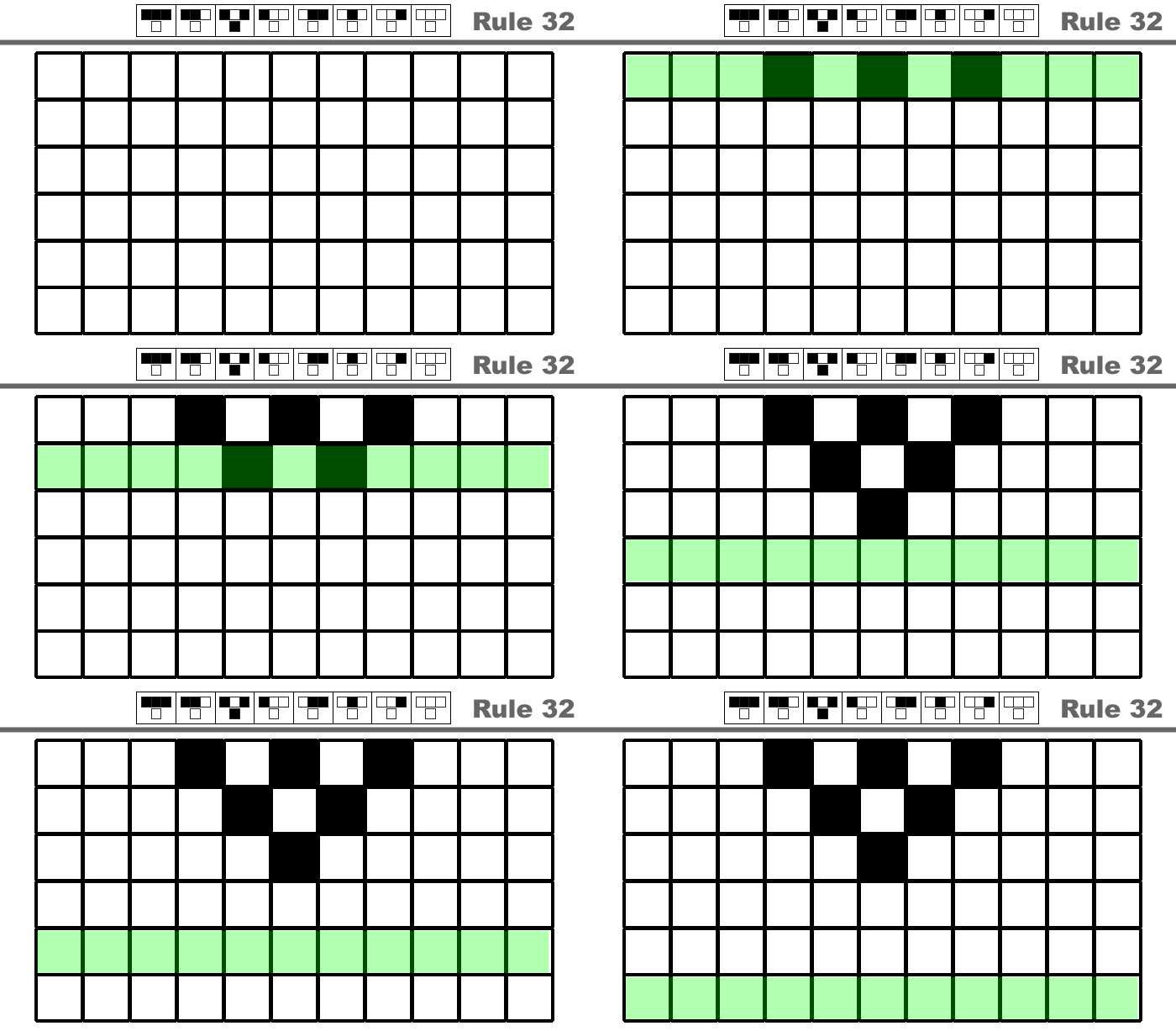
Even with randomized Black cells in row 1, the grid will always converge to all White.
Class 1 ECAs are pretty boring. They seem like a function that drives everything to 1 or 0.
Class 2 — Rule 250
Class 2 ECAs result in Periodicity —some kind of repeating pattern. I started this animation with only 1 black in the Center.
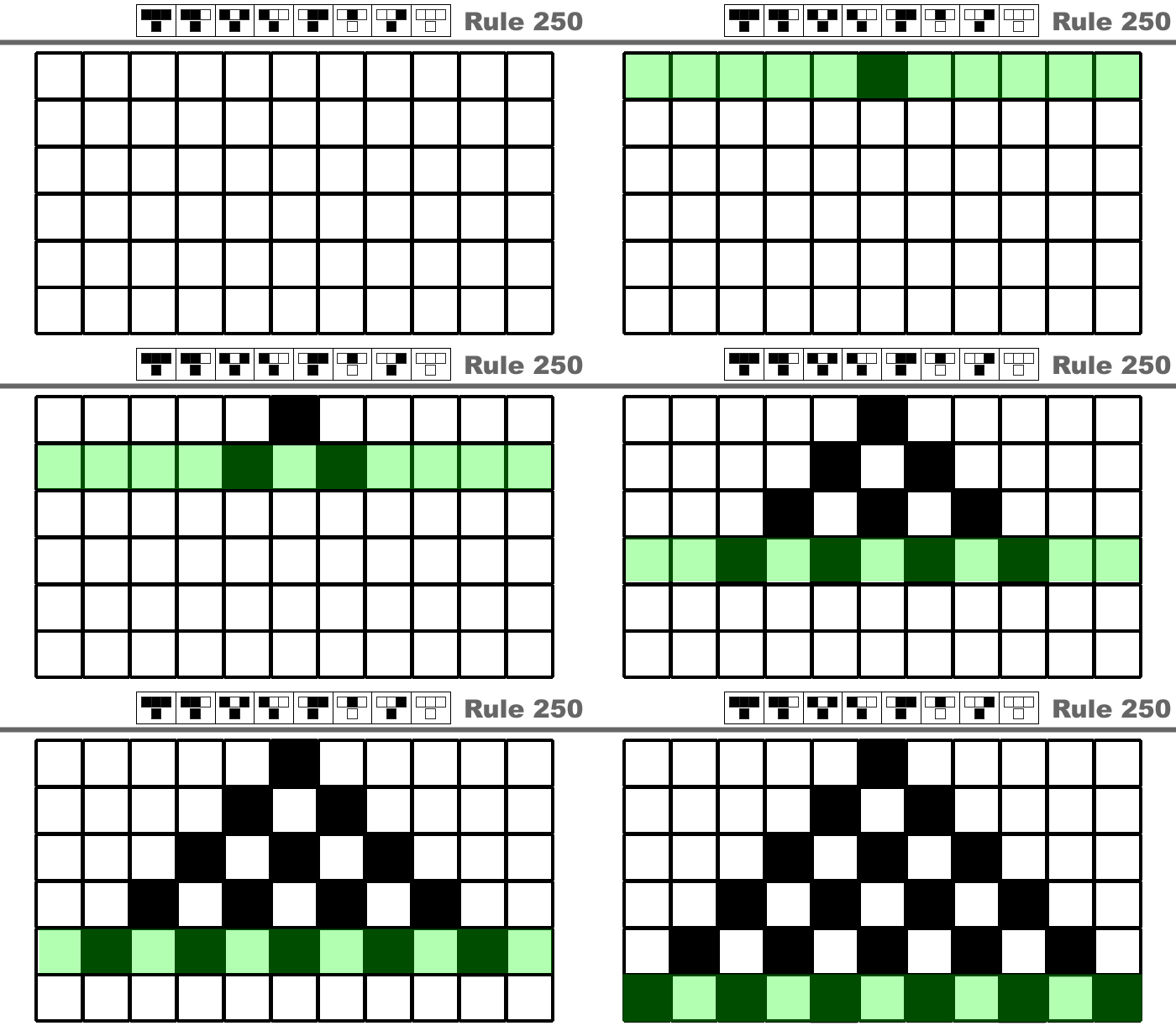
This rule causes the pattern to skip every other cell downward while also growing outward.
Rule 250 is commonly cited as an example of a Class 2 ECA, so I made an animation demonstrating that. However, if you look at the rule sequences, you will notice a lot of ways it could end up all Black — a Class 1 result. In fact, from a random assignment on the first line, Rule 250 usually ends up all black, and the expanding checkerboard pyramid I illustrated only arises from special starting positions. Rule 4 (only a single black above yields single black below  ) always results in repeating vertical lines (which is predictably boring).
Class 3 — Rule 30
Class 3 ECAs behave Chaotically — This is where things get interesting.
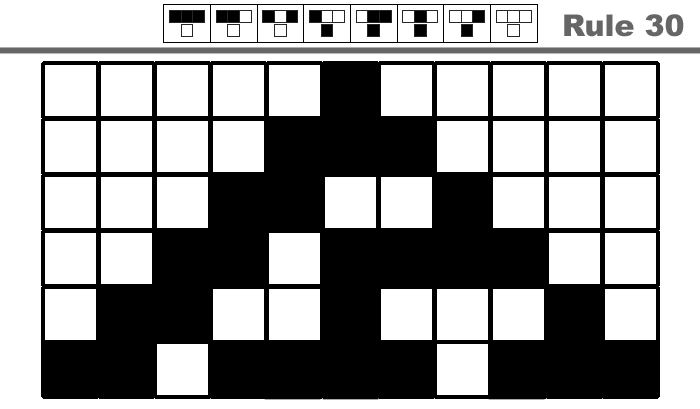
The pattern expands outward like Rule 250, but something less predictable is happening in the center cells.
The left side of the pattern looks like a little repeating staircase. The right side is repeating inverted Ts. But the white cells in the middle are more of a mystery. Perhaps if we extended further down, we would detect their pattern.
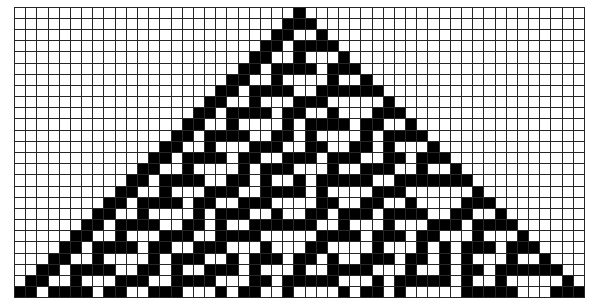
Unexpected Complexity allowed Stephen Wolfram to patent a Rule 30 based Random Number Generator.
If you think "divides by two, divides by three, divides by five..." you can see similarity to Prime Numbers and the Sieve of Eratosthenes. These patterns seem to emerge along the outer edges of the pyramid. But the center cells flowing downward are completely chaotic, and Wolfram used their spacing to drive a pseudo-random number generator.
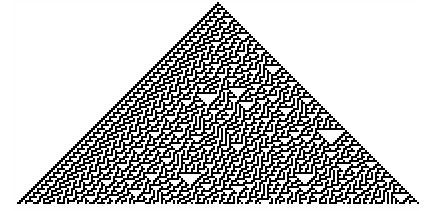
At 100 steps, the chaotic nature of Rule 30 becomes even more apparent.
Class 4 — Rule 110
Class 4 ECAs behave in a Complex way — capable of supporting "universal computation."
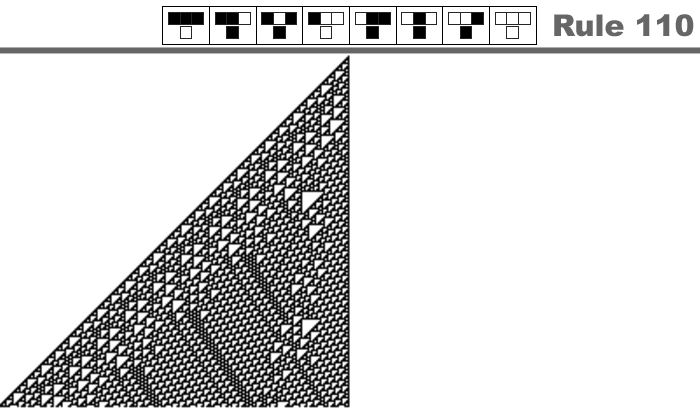
Here is an example for Rule 110, starting with a central black cell and jumping straight to 200 steps.
Rule 110 is neither completely stable, periodic, nor chaotic. Matthew Cook presented a proof at the Sante Fe Institute showing Rule 110 is "Turing Complete," utilizing shifts against a background pattern of "Space Ships." The part that caught my eye was a claim that the pattern of Space Ships shifts 8 pixels every 30 steps. Is "eight every thirty" part of a deeper pattern shared by ECAs and also the Prime Clock?
Cellular Automata Conclusion
I included this brief excursion into ECAs to show that other areas of math, despite extreme simplicity, can generate Deterministic and yet Chaotic behaviors. The ECAs accomplish this with a set of eight outcomes expressed through a series of self-referencing steps. Much like how the Prime Clock operates.
Limitations, Insights, and the Path Forward....
1. Like the naming of the "MANIAC" computer at Los Alamos, this is a bit of levity...