Philosopher Stones CONCLUSION
Not All that Glitters

March, 2026
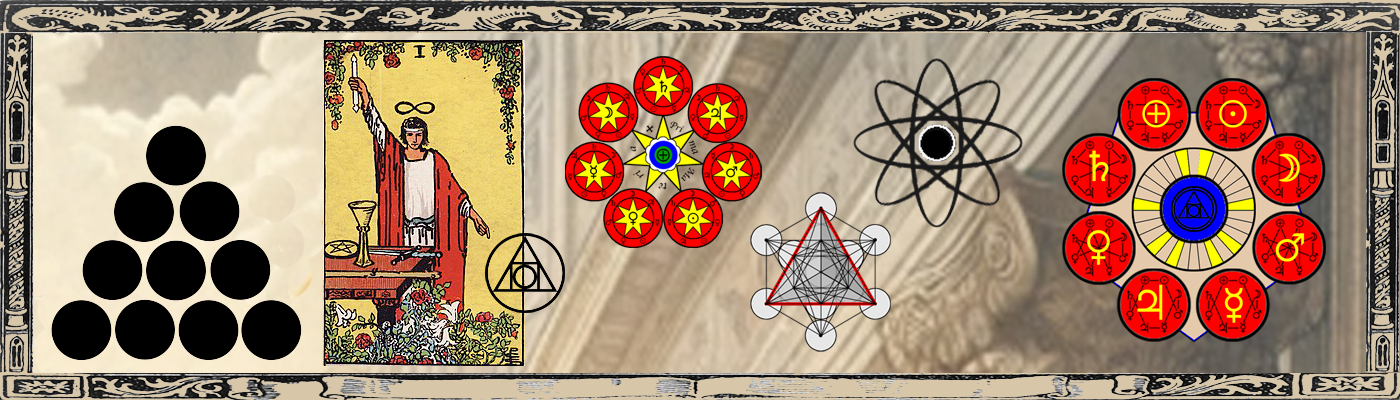
Previously on Philosopher Stones...
In Part One, we covered the age-old search for Divine Symmetry and asserted that "Prime Numbers are Elements of the Numeric Philosopher Stone."
In Part Two, we dove headfirst into the design and function of the Prime Clock. We revealed that while expressing impressive symmetry, the Prime Clock design was born from objective numerical output. The emerging patterns are specific to a 30-Slice Prime Wheel, and not from an appeal to mystical principles.
In Part Three, we advanced to specifics on the Golden Matrix and how it drives the Skip Matrix. Ultimately, knowing the exact Rotation and Slice is how the Prime Clock blocks production of Composite Numbers, while still leaving all the Primes.
In Part Four, the critics take a shot at explaining away the magnificence of the Prime Clock. Each concern is addressed.
In Part Five, we visit Euler's prime formula, Ulam's matching Spiral, and discover what is lucky about the number 41.
In Part Six, I introduce Elementary Cellular Automata to provide an example of how a set of eight parameters can generate Deterministic and yet Chaotic behavior.
Symbolic versus Geometric
This excursion into Prime Number generation began with my article "The Numbers" two years ago. It developed into a master class on Prime Wheels, but stopped short of endangering modern encryption. To break encryption would either require a new Symbolic manipulation method or...
The last option would be to engineer something like a Prime Wheel that produces every Prime number, but zero Composite numbers. There would be no Candidates requiring validation over an exponentially growing time frame. Instead of a simple Prime Wheel, though, I suspect it would require something more complex, like a Prime Clock.
--Darren Lott, "The Numbers CONCLUSION."In the Doomsday Mechanism, I covered both the success of creating a Prime Clock and also the reason it won't break Prime-based encryption. The numbers used for encryption are TOO FAR AWAY. Not too big — too far away. This distance provides protection against a Geometric approach. Let's look into what distance means for this problem and many other problems like it.
MMXXVI is our current year (2026) represented in Roman numerals. Romans had a few other letters that represented quantities: L=50, C=100, D=500. They had no symbol for zero, so no placeholder. They either concatenated symbols, adding to a value like XXX=30, or placed a smaller value just before a larger one to indicate subtraction, like XL=40. Romans created a symbol system to represent the kind of values that made sense in their lives. And it was very limited. Early Roman numerals could only represent up to 899, and the M=1000 symbol wasn't added until the Middle Ages. Consequently, something trivial to a student today, like adding 3 trillion to 4 trillion, would be out of reach for users of the early Roman numeral system.[1] The choice of symbol system can be either vastly empowering or devastatingly limiting.
Our Western Arabic numeral system is positional, which means the numeral "9" in the far right of a string means "nine" and when appearing in positions to the left will mean "ninety" and "nine hundred", etc. The Roman numerals are not like that, and "X" means "ten" regardless of position. It turns out that positionality is a kind of superpower for our numerical system. Shifting a numeral to the left in our system changes its value by a power of 10. We call this "base-10." We can decrease our base by eliminating symbols (base-8 uses 0,1,2,3,4,5,6,7) or increase the base by adding symbols (base-16 uses 0,1,2,3,4,5,6,7,8,9,A,B,C,D,E,F). The Roman system uses a base-5 (V=5, L=50, D=500) & base-10 system (X=1, C=100, M=1000).
Mixed bases were not limited to ancient Romans. The Babylonians used a base-10:base-60 system. The Mayans used a base-5:base-20 system. Both civilizations were able to accomplish amazing feats in civil engineering and timekeeping. Trying to break encryption has been exhausted utilizing our positional, single-base system. Changing to binary, or hex, or... is really just trying the same thing. If one created a new numerical system following the pattern of the Prime Clock, would that yield results? I don't want anyone to do that, and it seems dangerous to present my sleeping mind with this type of challenge. If I do find a way to accomplish this, I won't write anything about it.
Distance
The advantage of symbolic problem-solving is that it can manifest REAL MAGIC solutions. When I gave the example of symbols allowing us to easily add 3 trillion and 4 trillion, we get an accurate answer without having to traverse the impossibly long task of counting everything. It's not just math that allows this, but symbolic math, and in fact, a particular structure onto which the symbols are placed. The Romans had a "V" as a symbol for five, and we use "5," but the positional system we use allows the magic to extend further.
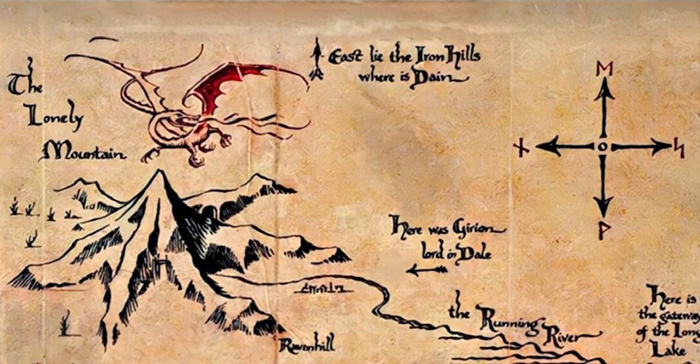
Thorin's Map from "The Hobbit" with symbols for River, Mountain, and Dragon.
A map is an abstract REPRESENTATION, but not a symbol itself. A map provides an organization for symbols, that are generally shared across different maps. Different maps represent different territories. A set of symbols without the organization of a map is not useful for navigation.
A map lets us travel great distances in our minds without physical travel. We can undertake solving problems without confronting them directly yet. A map is abstract, but the symbols on it are a level more abstract. And a contextual symbol like "5" that can mean "fifty" or "five thousand" is even more abstract and more useful than a fixed symbol (like the Roman "V").
When I contrast 'Symbolic' and 'Geometric,' you may think both are equally abstract, and geometry just specializes in the attributes of primary shapes — circle, triangle, square. However, if we break down the word origins of 'symbolic' and 'geometric,' we discover a more complete story. The word 'Symbolic' originates from "together" and "to put" — Symbolic is to put two things together, at least one of which is not physical. It is an intentional association between a thing that exists and an abstraction intended to represent that thing. All magic relies on attempts at symbolic manipulation – to change a thing in the World by manipulating the symbol and without physically interacting with the thing directly. Don't think "Cups and Balls," but rather "Voodoo Doll" to grasp this.
The word "Geometry" originates from "earth" and "measure." It was originally a discipline intended to model the physical World. Four thousand years ago, geometry was a collection of empirical principles used in land surveying, construction, and astronomy. It was useful and solidly grounded by heuristics. It was not a collection of tricks memorized for manipulating symbols. However, as the history of math progressed, symbolic techniques were layered on top. Euclid's Elements is credited with adding a notable layer of abstraction and reasoning. Consequently, Euclid's approach is known as "Synthetic Geometry."
Pythagorean Theorem; Pythagorean Theology
In The Elements, I mentioned the formula a2 + b2 = c2. This is credited to Pythagoras and certainly seems like the kind of abstract symbolism I claim is the opposite of grounded geometry. We voice the little superscript two (2) in the formula as "squared" without realizing the connection to its geometric namesake. "A squared plus B squared equals C squared." The diagram below helps illustrate the meaning of "squared."
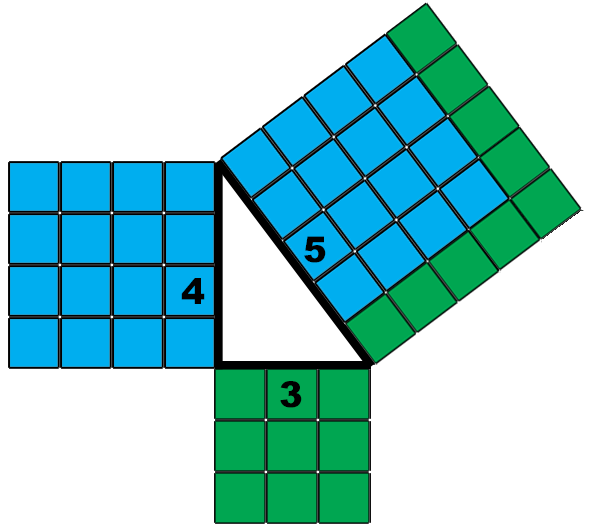
32 + 42 = 52
You can see that the formula is not magic symbols pulled from the air, but rather, the arrangement of symbols is driven by the observed interaction between squares and a right triangle. A formula like this originates from many valid observations and perhaps some invalid ones as well, testing the limits of the mapping.
The Pythagoreans had their own method for "Pythagorean primes." Essentially, they said the sum of an odd square and an even square results in a sum (4n + 1). The first Pythagorean primes are 5,13,17,29,37,41,53,61,73,89,97,101,109...
If you look at the sequence, you will see it is missing quite a few legitimate primes (e.g., 7, 11, 19, 23... ). If you play with the formulas, you can get the listed Pythagorean primes, but even the diagram numbers (32+42 = 25 = 4(6)+1) pass their test while resulting in the non-prime 25.
Although the Pythagoreans weren't very good at generating prime numbers, they did hold "numbers to be the elements of all things."[2]
Consider that ALL numbers are either prime or composites of prime numbers. Primes are the atoms of the number system. Composites are molecules. Without primes, there are no composite numbers, and our ability to assign quantity to the world ends abruptly. It's a funny notion.
The Pythagoreans sought Divine Symmetry in the relations between shapes and quantities, but focused only on squares and triangles. That was a bit of a wrong turn. They were looking for a Divine Symmetry that revealed the prime numbers. They were searching for the first Philosopher's Stone, and they didn't find it. What they left was a geometric paradigm based on squares and triangles, and not intersecting circles that reveal the answer[3].
Alchemy's Circular Reasoning
In Early Greek cosmology, Chaos was the first thing to exist. Chaos's polar opposite, Cosmos, means "orderly arrangement," which arises from Chaos. Pythagoras is said to have been the first to use the word "Cosmos" to represent "the Universe."
The Alchemists hoped to find the Principles that converted the Ancient Chaos into the orderly Universe. The pattern for the Ancient Chaos diagram embraces the circular nature of the Cosmos. It breaks the spell of triangles and squares that captivated the Pythagoreans. However, I was unable to decipher meaningful information from their diagram, and my analysis in Comprisation Part Five reveals it to be combinatorially incomplete. The circular symmetry is compelling, but it appears to be another blind alley.
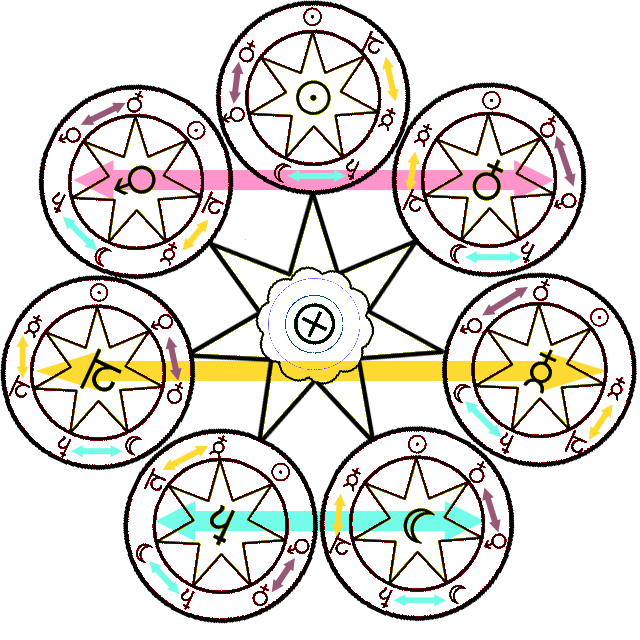
Ancient Chaos diagram rotated with Sun (Gold) at top
and other parings revealed. Was it merely a failed theory?
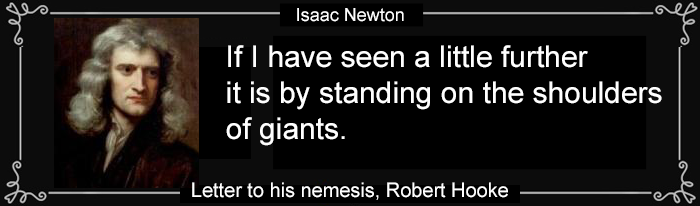
Avoid the Shoulders, and Shadows of Giants
A repeated theme on this site has been my trying to solve an "impossible problem" and win a million dollars. Traveling Salesman was the first, but The Numbers also mentions the prize for Prime Number encryption, which could lead to wealth or assassination.
But to be more accurate, the Millennium Problems are seven famously unsolved problems. The Clay Mathematics Institute offered a million dollars each for the first solution. (Since 2000, one prize has been claimed.[4])
There is no specific Prime Number prize, but rather a prize for proving the Riemann Hypothesis. This has been unsolved since 1859, when Bernhard Riemann published "On the Number of Primes Less Than a Given Magnitude." That seems like a topic suited to the Prime Clock. However, the phrasing of the prize problem is thus:
Do all non-trivial zeros of the Riemann zeta function have a real part equal to one-half?
Since the scope is just the number of primes less than a given magnitude, it seems WAY less ambitious than actually generating all said primes. To be fair to mathematicians before modern computers, conjecture about prime behavior was about all they had within their power.
On the other hand, it certainly seems like a way to make a difficult problem, like generating all Primes, a lot more obscure. "Non-Trivial Zeros?" "A Real Part?"
Riemann Zeta Function
The reference to a "Real Part" is because the Riemann Zeta Function utilizes the "imaginary number i," defined as the square root of -1. Since the square root of a number times itself is that number, and a negative number times itself is a positive number, you might think "impossible" is more descriptive of √-1 than "imaginary."
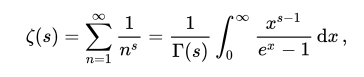
Riemann Zeta Function of a complex variable s = σ + it,
where σ and t are real numbers. And i is imaginary.
Wikipedia has a plot of the "real" and "imaginary" output of this function. Not to be too glib, but this seems to explain why a problem framed this way would go unsolved for over 160 years.
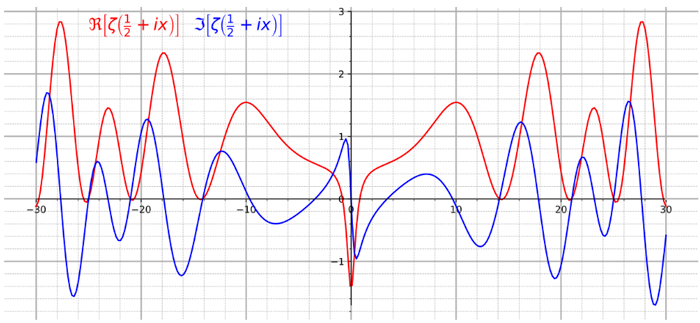
Riemann Zeta Graph. The Red line is for the Real Number portion,
and the Blue Line is for the Imaginary portion.
I won't ask you to try to understand this any further. But I looked at the graph annotation and can see that where the Red and Blue lines intersect at zero, those were the target values. So, a bit like my notion of Fourier waves, but the zeta intersection values don't seem familiar (±14.135, ±21.022 and ±25.011).
Möbius Inversion
To help obtain the actual count of Primes, which was Riemann's original goal, a "Möbius Inversion Function" is applied. It extends the zeta function to look like this:

Riemann Möbius Function with even more of the requisite "magic symbols."
The Möbius function (1832) is part of the inversion function above, and finally gives us a clearer connection between the fascination with -1 and the mapping of Primes:
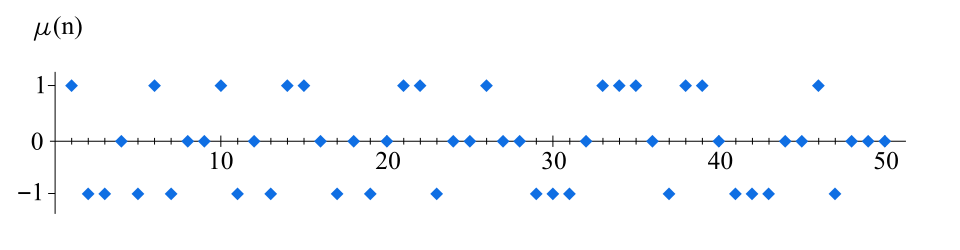
First 50 plot points of the Möbius Function. All values are either 1, 0, or -1.
Points on the zero line will not look familiar. But if you look only at the -1 value plots, you will notice something familiar; they occur at {2,3,5,7,11,13,17,19...}. Wow.
The problem, however, is that 30 and also 42 are included. And that's just the first fifty numbers. Möbius is another imperfect method for generating primes, and it's at the base of methods that followed after 1832. Embed something flawed into a complex symbolic notation and you render occult the real solution for centuries.
If you are only interested in the statistical properties of the Prime number distribution, then you could overlook inheriting a flawed generation system, as long as its output matches statistically. Omit a Prime here and add a Composite there; it won't seem relevant because the stats could still match.
Three Final Takeaways
The first and most obvious is:
The Prime Clock is the Geometric solution to Prime Number generation.
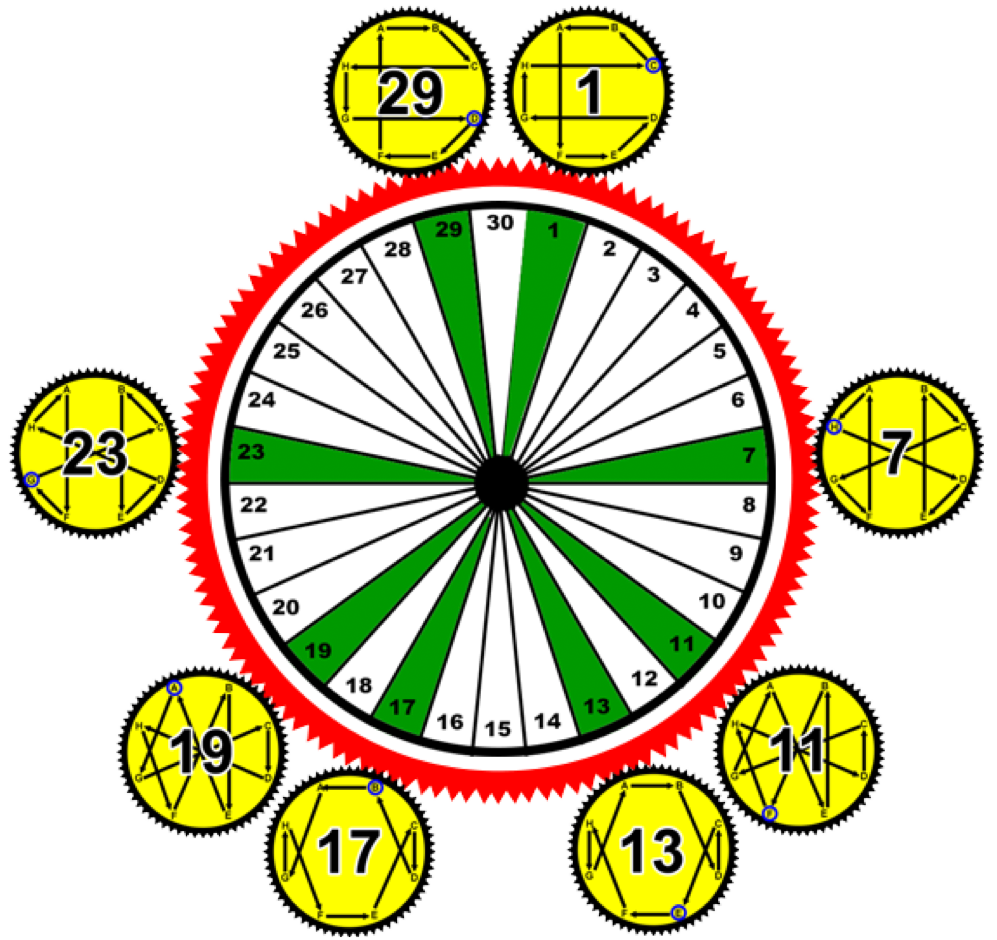
Aside from producing all Prime Numbers and no Composites, the unique Symmetry should be inspirational in other areas of science too. However, if I submitted the Prime Clock design to a mathematics journal, I would need to omit any discussion of Epiphany, Alchemy, or Divine Symmetry. Just the numbers would need to suffice. Ironically, it might be too simple to be accepted. Where are Calculus and Imaginary Numbers?
The second takeaway was presented in Comprisation:
A valid answer to one problem can invisibly prohibit an overall solution.
This is analogous to a wrong turn in a maze, but where you're unable to tell you're not finished. If "Giants" led you to an unsolvable problem, jump off their shoulders and start a new route.
The final takeaway involves a warning about symbols:
Symbolic manipulation can make great distances traversable. But even the smallest misassumption or error will leave you inexplicably stranded. Sometimes you have to set aside your Hobbit Map, pick up your sword, and go confront the Dragon.
The Prime Clock is the radical departure needed to solve a long standing problem. What will it take for it to gain acceptance?
If you think of further Criticisms about the veracity of these claims, or have advice on how best to protect and disseminate this novel idea, please let me know! You can also leave thoughtful comments or questions at the "Comments" link below.
1. To deal with larger quantities later on, the Roman numeral system was expanded to include a "viniculum." This was a bar drawn over standard symbols indicating TIMES 1,000. So M is 1,000 x 1,000 = 1,000,000. A million! And an even fancier addition was a bar at both ends to indicate TIMES 100,000. So |M| would be 1,000,000 x 100,000 = 100,000,000,000. A hundred billion. Above that, you are counting repeating symbols again.
2. From the longer Aristotle quote in Part One.
3. If you look up "Pythagorean Circles" you will find they are used in service of just more square and triangle geometry.